

Lead nurturing
How to use a case study in lead nurturing
Use a case study when a real, approved example addresses the prospect’s current decision. Explain relevant context and limitations rather than suggesting the same result is guaranteed for another business.
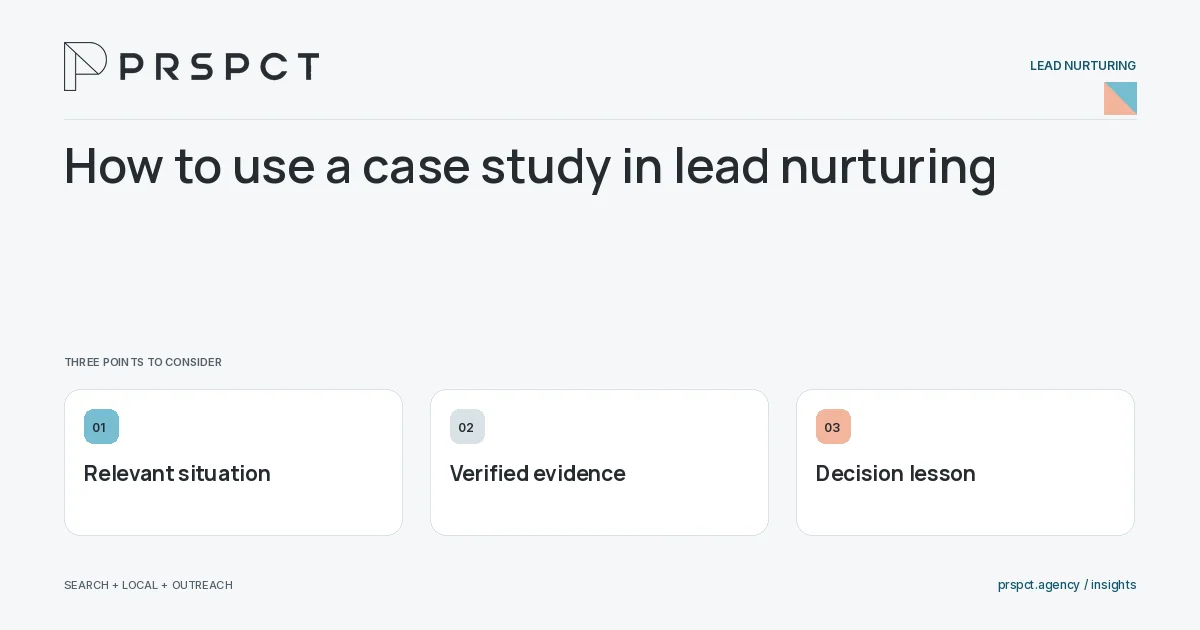
Evidence needs a reason to appear in the conversation.
Match the situation
Choose a case relevant to the service, problem, and stage.
Present verified facts
Use approved scope, dates, outcomes, and attribution limits.
Connect the lesson
Explain what the example helps evaluate and invite an appropriate question.
A practical example
A fictional provider shares a permissioned process example about implementation responsibilities when that is the buyer’s concern. It does not attach an unrelated revenue headline.
A decision checkpoint
A case study should not be chosen only because its number is impressive. Select evidence relevant to the prospect’s question and explain the situation. A modest process example can be more helpful than an unrelated performance claim that does not answer the current concern.
A mistake to avoid
Using an invented case study creates false proof instead of useful evidence.
How to assess the result
Review whether recipients ask more informed questions and whether the evidence remains current.
Put the work in context
Lead nurturing helps a relevant prospect resolve questions over time. It should follow the person’s relationship and expectations, rather than interpret every content interaction as readiness for a sales pitch.
Plan the next useful decision, who owns the relationship, and when follow-up should stop. Coordinate with sales so that automated messages do not contradict an active conversation or ignore a stated preference.
A common question
What if a business has no case studies?
Use clearly labeled illustrative examples and honest process explanations rather than inventing client results.
Related reading
- Lead nurturing for small businesses: a useful strategy
- Educational versus promotional emails in a nurture plan
- Lead nurturing audit checklist for a small team
- Email marketing for small businesses: a practical starting guide
Discuss your next priority
PRSPCT helps businesses connect search visibility, local presence, and email outreach. Email josh@prspct.agency to discuss your goals.
References and further reading
The references below support relevant platform definitions and requirements. The planning workflows and labeled examples are PRSPCT editorial guidance.