

SEO measurement
Cost per lead versus cost per qualified lead
Cost per lead divides acquisition cost by counted leads; cost per qualified lead uses only inquiries meeting an agreed qualification standard. Both require consistent cost scope and counting rules.
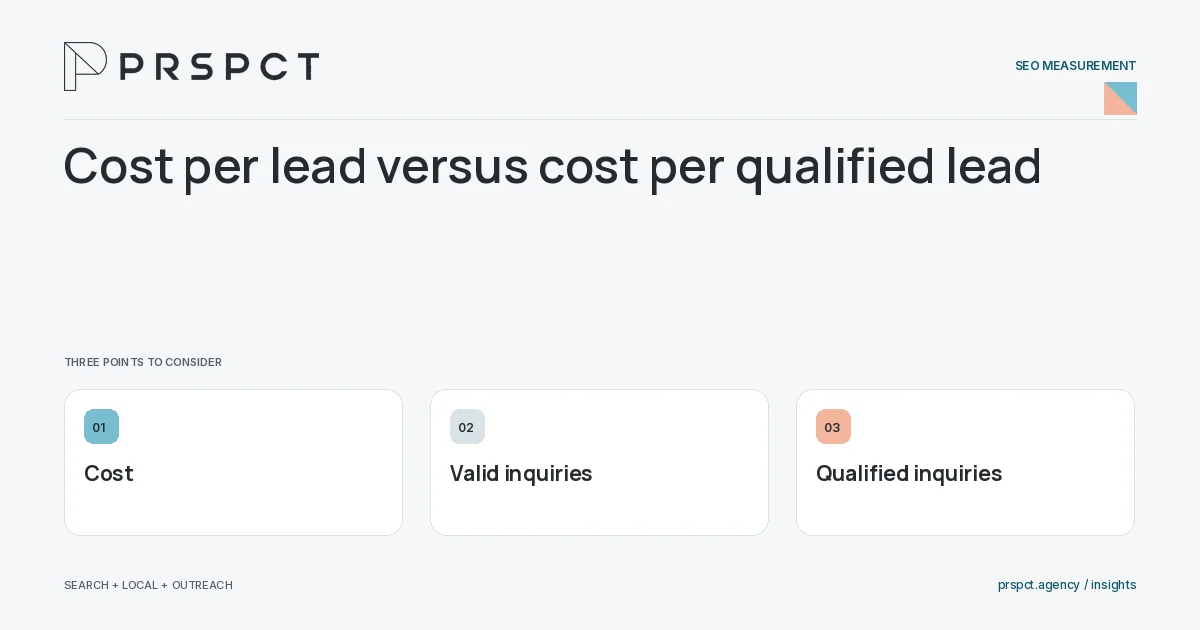
A lower lead cost can hide a poorer audience fit.
Define the denominator
Specify valid and qualified inquiries separately. Keep duplicates and tests out of both.
Include the cost scope
Record media, campaign work, software, and other included costs. Do not compare reports using different scopes.
Compare downstream quality
Review sales conversations and customers as well as cost. Cheap inquiries are not automatically efficient acquisition.
A practical example
Illustrative arithmetic: $1,000 divided by 50 valid inquiries is $20 per inquiry. If 10 qualify, cost per qualified inquiry is $100. The invented example shows why the denominator matters.
A decision checkpoint
Compare lead quality with the cost definition. A campaign using only media spend should not be presented beside another including content and sales time without explanation. The calculation can be simple, but the scope must remain visible for the result to guide a spending decision.
A mistake to avoid
Changing qualification rules mid-comparison can manufacture an apparent improvement.
How to assess the result
Report costs, counts, definitions, and time periods together. Use realized sales outcomes as additional context.
Put the work in context
Measurement is useful when it helps the business choose its next action. Separate search exposure, website behavior, valid inquiries, and sales outcomes; each describes a different part of the journey.
Keep metric definitions stable and record important site changes. Compare similar periods where possible, and explain data gaps instead of presenting a partial dashboard as a complete account of customer behavior.
A common question
Which metric should owners prefer?
Use both with clear definitions, then connect them to sales outcomes and acquisition economics.
Related reading
- SEO reporting for small businesses: what to measure
- SEO dashboard template for an owner-led business
- Marketing attribution for small businesses: practical limits
- What is answer engine optimization? A practical AEO guide
Discuss your next priority
PRSPCT helps businesses connect search visibility, local presence, and email outreach. Email josh@prspct.agency to discuss your goals.
References and further reading
The references below support relevant platform definitions and requirements. The planning workflows and labeled examples are PRSPCT editorial guidance.