

SEO measurement
Lead quality reporting: what marketing and sales should agree on
Lead quality reporting requires shared definitions of fit, readiness, validity, and outcome. Marketing and sales should record rejection reasons and use them to improve targeting and content.
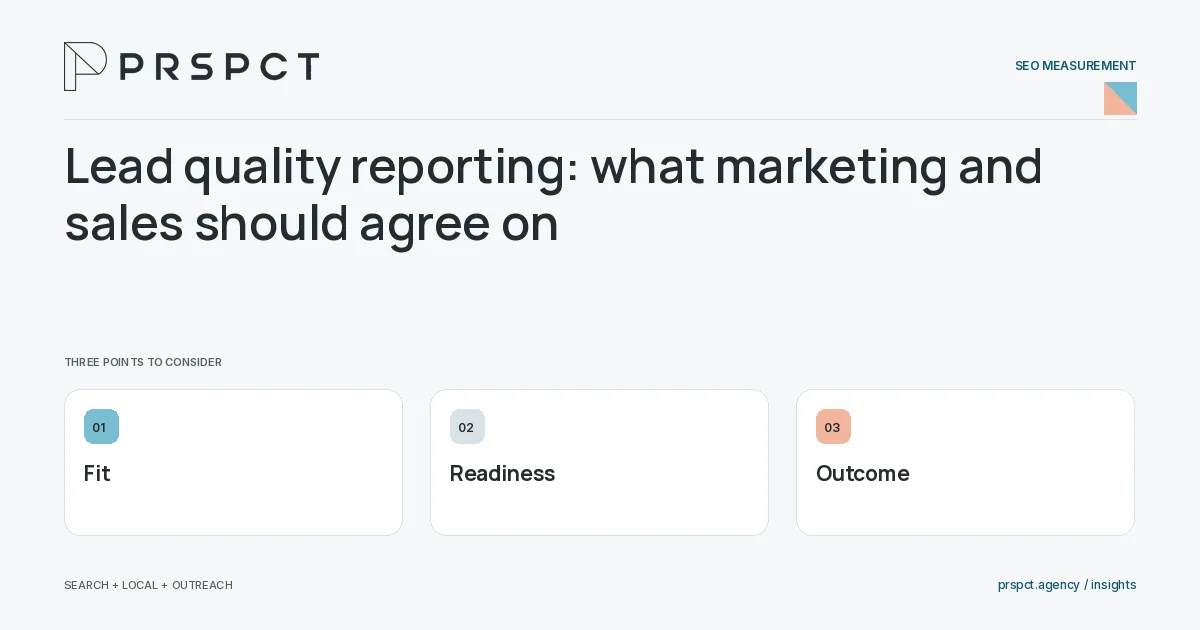
Without agreement, the same inquiry may be counted as success by one team and failure by another.
Define fit
Specify service, location, organization type, and other legitimate requirements. Keep subjective labels out.
Record status reasons
Distinguish unqualified, not ready, unreachable, duplicate, and declined. Each suggests a different improvement.
Close the feedback loop
Review patterns with campaign owners and update messaging or routing where evidence supports it.
A practical example
A fictional provider learns that many “bad leads” actually need a later start date. It separates readiness from fit and uses an appropriate permission-based follow-up rather than rejecting the audience entirely.
A decision checkpoint
Review rejection reasons with examples. A label such as “wrong fit” can drift unless the teams periodically compare what it means in practice. Use anonymized cases to maintain consistency and identify whether the problem belongs in targeting, page wording, qualification, or response handling.
A mistake to avoid
A single “bad lead” bucket hides actionable differences.
How to assess the result
Track the proportion and count in each status, then review resulting conversations and customers.
Put the work in context
Measurement is useful when it helps the business choose its next action. Separate search exposure, website behavior, valid inquiries, and sales outcomes; each describes a different part of the journey.
Keep metric definitions stable and record important site changes. Compare similar periods where possible, and explain data gaps instead of presenting a partial dashboard as a complete account of customer behavior.
A common question
Should every lead receive a numeric score?
No. Clear stages and reasons may be more useful than a complex score for a small team.
Related reading
- SEO reporting for small businesses: what to measure
- UTM naming conventions for small-business marketing
- What is answer engine optimization? A practical AEO guide
Discuss your next priority
PRSPCT helps businesses connect search visibility, local presence, and email outreach. Email josh@prspct.agency to discuss your goals.
References and further reading
The references below support relevant platform definitions and requirements. The planning workflows and labeled examples are PRSPCT editorial guidance.