

SEO measurement
How to measure an SEO content update responsibly
Measure a content update by recording what changed, choosing relevant page and query outcomes, and comparing suitable periods. Treat the result as observational unless the conditions support a controlled experiment.
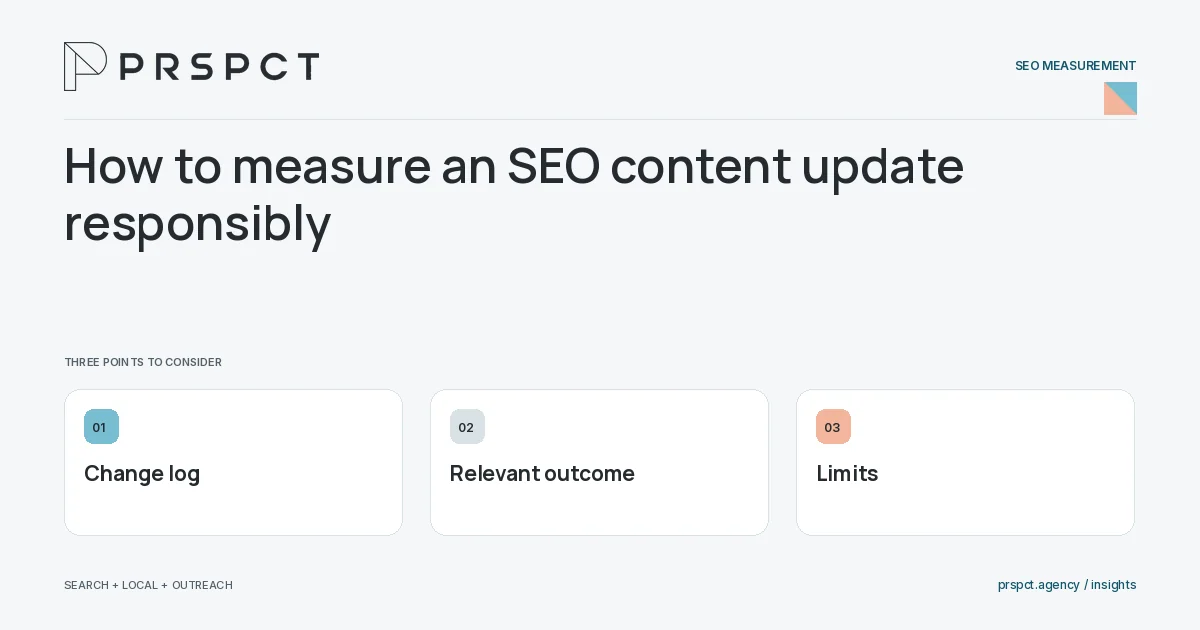
Seasonality, competition, and other releases can affect the same period.
Record the intervention
Save the date, affected sections, metadata changes, and intended improvement. Avoid unrelated simultaneous changes when practical.
Choose matching signals
Review relevant queries, clicks, engagement, and inquiries that relate to the intended task.
Explain uncertainty
Note traffic size, demand shifts, and other changes. Do not claim causation solely from before-and-after movement.
A practical example
A fictional guide adds an answer to a recurring preparation question. Later relevant queries grow, but the team describes the change as a plausible contribution rather than proof of a single ranking factor.
A decision checkpoint
Decide what observation would challenge the hypothesis. If the update was intended to clarify fit, more irrelevant clicks would not necessarily indicate success. A good review asks whether the intended decision improved, not simply whether any favorable metric moved after publication.
A mistake to avoid
A one-day increase after editing does not establish a reliable result.
How to assess the result
Use enough observations for the decision and preserve the same filters across periods.
Put the work in context
Measurement is useful when it helps the business choose its next action. Separate search exposure, website behavior, valid inquiries, and sales outcomes; each describes a different part of the journey.
Keep metric definitions stable and record important site changes. Compare similar periods where possible, and explain data gaps instead of presenting a partial dashboard as a complete account of customer behavior.
A common question
Is every before-and-after comparison an A/B test?
No. Without controlled allocation, it is usually an observational comparison with confounding factors.
Related reading
- SEO reporting for small businesses: what to measure
- Marketing attribution for small businesses: practical limits
- Search Console versus GA4: why the numbers differ
- What is answer engine optimization? A practical AEO guide
Discuss your next priority
PRSPCT helps businesses connect search visibility, local presence, and email outreach. Email josh@prspct.agency to discuss your goals.
References and further reading
The references below support relevant platform definitions and requirements. The planning workflows and labeled examples are PRSPCT editorial guidance.