

Cold email outreach
Cold email opening lines that do not pretend familiarity
A useful cold opening identifies a truthful business context and connects it to a relevant question. Avoid fake compliments, invented research, and wording that implies a conversation that never happened.
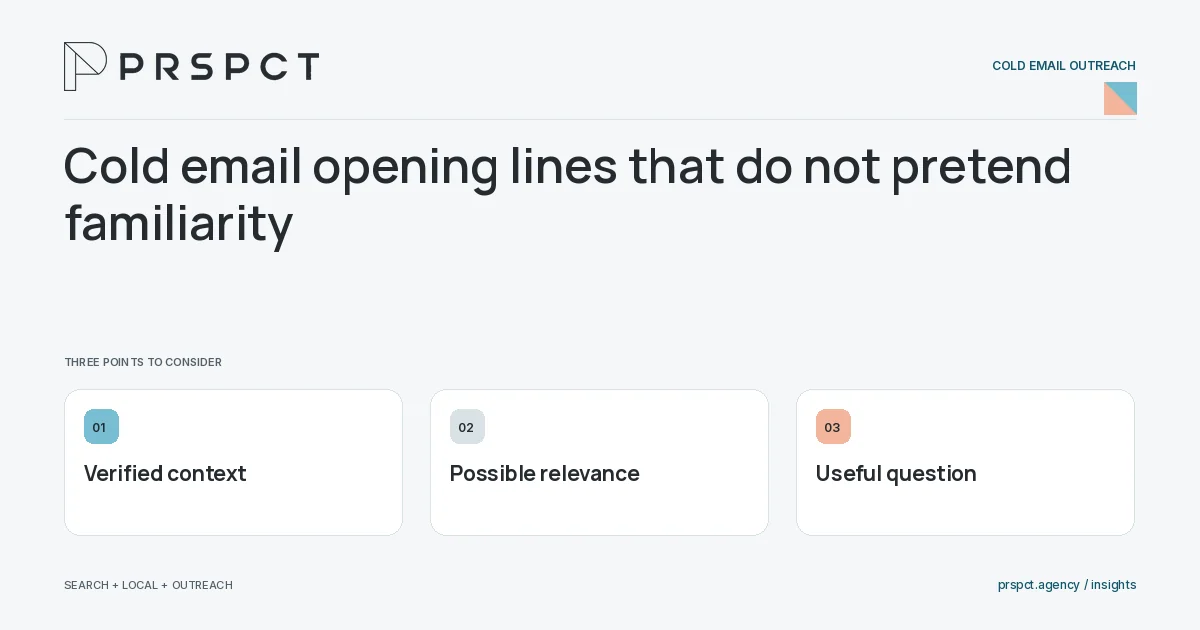
The opening should explain why this organization was selected.
Use a real fact
Check the organization’s own current information.
Connect cautiously
Present the service relationship as a possibility, not a diagnosis of a hidden problem.
Move to usefulness
Offer a clear next step without a long self-introduction.
A practical example
Illustrative opening: “Your website lists several commercial service locations. We work on inquiry routing across service teams; is that something your team is reviewing?” It does not claim known failures.
A decision checkpoint
An opening should remain truthful when the recipient asks how you know the fact. Keep the source available and avoid wording that turns a public observation into a private diagnosis. A cautious relevant question is more defensible than a confident claim about a problem you have not verified.
A mistake to avoid
“I have been following you for years” is misleading when generated without a real basis.
How to assess the result
Review factual accuracy and whether responses confirm relevance.
Put the work in context
Cold outreach should be honest about the sender, relationship, and reason for contact. Keep campaigns bounded and relevant, maintain required disclosures and preferences, and follow applicable laws and provider policies before any send.
The examples here illustrate message structure, not a complete send-ready campaign. Use verified sender details and any required physical address or disclosures, and do not invent recipient problems, prior conversations, or results claims.
A common question
Must every opening include praise?
No. A concise, truthful business reason can be more useful than generic flattery.
Related reading
- Cold email outreach for small businesses: a practical framework
- Cold email subject lines: clear beats deceptive
- Cold outreach cadence: set limits before launching
- Digital marketing for small businesses: a practical starting plan
Discuss your next priority
PRSPCT helps businesses connect search visibility, local presence, and email outreach. Email josh@prspct.agency to discuss your goals.
References and further reading
The references below support relevant platform definitions and requirements. The planning workflows and labeled examples are PRSPCT editorial guidance.