

Cold email outreach
Cold email outreach for small businesses: a practical framework
Cold outreach initiates contact with a prospect who has not requested the message. Plan a relevant audience, truthful business context, proportionate request, and reliable reply and opt-out handling before sending.
It should remain distinct from a subscriber newsletter.
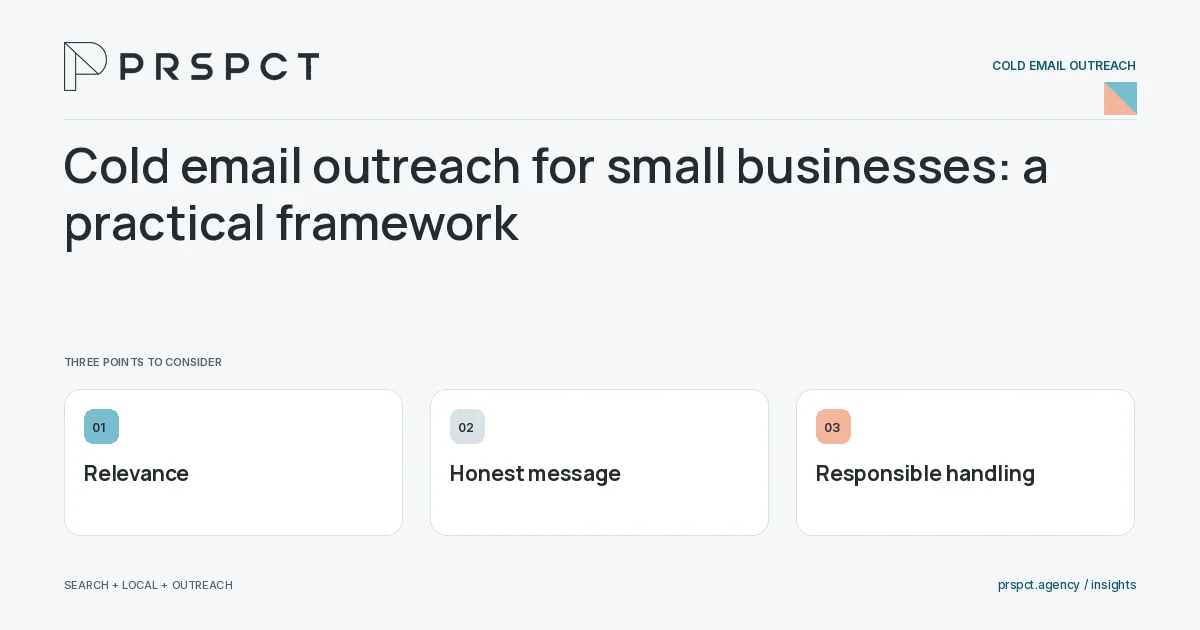
Establish relevance
Use verified business context and a service the organization could plausibly need.
Write a clear message
Identify the sender and explain the possible connection without pretending familiarity.
Prepare operations
Review applicable requirements, suppression, replies, qualification, and stopping rules.
A practical example
A fictional service provider asks whether a relevant preparation checklist would help the appropriate team. It avoids a fabricated warning about poor performance.
A decision checkpoint
Define who will read and interpret replies before launching. A campaign can create an appropriate conversation only if someone handles questions, mismatches, and stop requests correctly. Do not let the sending sequence run independently from the receiving inbox and the business’s capacity to follow through.
A mistake to avoid
A large send does not compensate for a weak reason to contact someone.
How to assess the result
Track suitable conversations and negative feedback, not raw sending volume.
Put the work in context
Cold outreach should be honest about the sender, relationship, and reason for contact. Keep campaigns bounded and relevant, maintain required disclosures and preferences, and follow applicable laws and provider policies before any send.
The examples here illustrate message structure, not a complete send-ready campaign. Use verified sender details and any required physical address or disclosures, and do not invent recipient problems, prior conversations, or results claims.
A common question
Is cold outreach automatically appropriate because it is B2B?
No. Assess laws, provider policies, context, and recipient preferences.
Related reading
- Cold email opening lines that do not pretend familiarity
- B2B follow-up emails: add context rather than pressure
- Digital marketing for small businesses: a practical starting plan
Choose a related question
Cold email opening lines that do not pretend familiarity
A useful cold opening identifies a truthful business context and connects it to a relevant question. Avoid fake compliments, invented research, and wording that implies a conversation that never happened.
Cold email subject lines: clear beats deceptive
A cold subject line should accurately describe the message and avoid implying a prior reply, urgent account issue, or personal relationship that does not exist. Clarity protects the recipient’s ability to judge relevance.
Low-pressure calls to action for B2B outreach
A proportionate outreach CTA asks for a useful small next step, such as confirming relevance or reviewing an appropriate resource. It should not assume interest or demand a meeting before the recipient understands the connection.
B2B follow-up emails: add context rather than pressure
A useful follow-up adds relevant information or clarifies a reasonable question without pretending the recipient owes a response. Keep the sequence bounded and honor requests to stop.
Cold outreach cadence: set limits before launching
An outreach cadence defines when contact occurs, what each message contributes, and when it stops. Choose it from audience context and operational constraints rather than a universal maximum-contact formula.
How to categorize B2B outreach replies
Categorize replies by useful meaning: interested, needs information, later timing, not a fit, wrong route, out of office, or stop request. Route each category to an appropriate action rather than counting every response as success.
Positive replies versus booked meetings in outreach reporting
Positive replies, booked meetings, attended conversations, and qualified opportunities are different outcomes. Define each and report counts with consistent denominators before comparing campaigns.
How to run a small B2B outreach pilot
A useful outreach pilot tests audience fit, message relevance, operational controls, and reply handling at a manageable scope. Define learning goals and stopping conditions before expanding.
Responding to “not interested” in B2B outreach
Treat a clear lack of interest respectfully and honor any request to stop. Do not convert a rejection into an argument or continue a sequence automatically because the person did not use a particular phrase.
Discuss your next priority
PRSPCT helps businesses connect search visibility, local presence, and email outreach. Email josh@prspct.agency to discuss your goals.
References and further reading
The references below support relevant platform definitions and requirements. The planning workflows and labeled examples are PRSPCT editorial guidance.