

Content strategy
Content gap analysis using sales and support questions
A content gap is an important audience question your current resources do not answer adequately. Find gaps by comparing customer decisions with existing pages, then decide whether to improve a section or create a distinct resource.
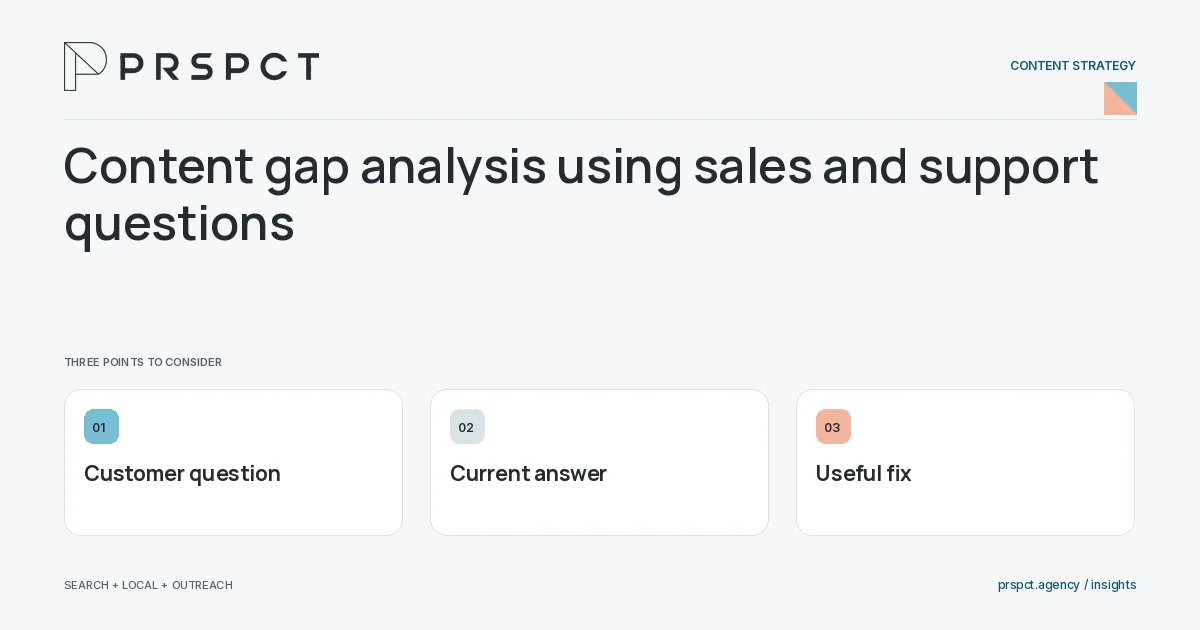
A missing keyword is not always a missing page.
Collect decision evidence
Review permitted sales notes, recurring support questions, and service objections. Remove personal information.
Audit the current answer
Find where the question is addressed and assess whether a reader could act from that explanation.
Choose the smallest useful fix
Expand a relevant section or build a separate guide when depth and intent justify it.
A practical example
A fictional provider hears repeated questions about implementation responsibilities. It adds a responsibility table to the process page instead of publishing another broad definition article.
A decision checkpoint
A gap may concern explanation quality rather than subject coverage. If the topic is already present, ask what the visitor still cannot do after reading it. A worked example or responsibility table may solve the problem more effectively than another page with a similar headline.
A mistake to avoid
Treating every competitor topic as a gap can overwhelm the plan with irrelevant work.
How to assess the result
Track whether the new answer is used in real conversations and attracts the intended questions.
Put the work in context
A content strategy should explain why each resource belongs on the website. Useful coverage supports real customer decisions; a larger publishing calendar is not automatically a stronger one.
Maintain a topic map with the preferred URL, intended reader task, evidence, and next action. Review overlap before drafting and revisit the map when customer questions or the business offer change.
A common question
Can a content gap be fixed without a new blog post?
Yes. A clearer section, table, or service explanation may be the better solution.
Related reading
- Content marketing for small businesses: build a useful library
- How to prevent keyword cannibalization before publishing
- How to repurpose a blog into subscriber emails
- SEO reporting for small businesses: what to measure
Discuss your next priority
PRSPCT helps businesses connect search visibility, local presence, and email outreach. Email josh@prspct.agency to discuss your goals.
References and further reading
The references below support relevant platform definitions and requirements. The planning workflows and labeled examples are PRSPCT editorial guidance.