

Content strategy
Content marketing for small businesses: build a useful library
Content marketing creates useful resources that help a relevant audience understand problems and decisions. For a small business, begin with sales questions and service knowledge rather than a publishing quota.
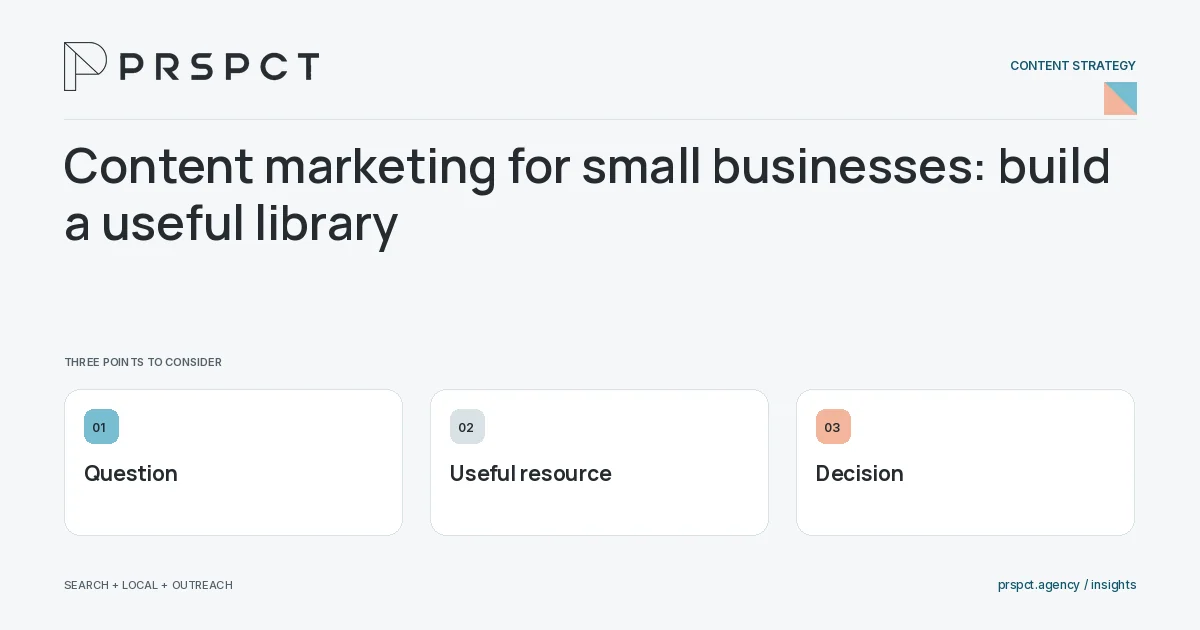
The library should give customers a clearer path to understanding the offer.
Map the journey
Identify questions about recognizing a need, comparing approaches, preparing, and choosing a provider.
Choose meaningful formats
Use checklists for preparation, comparisons for tradeoffs, and guides for tasks. Let the question shape the format.
Connect the resources
Link related decisions and the appropriate service explanation. Keep each page’s purpose distinct.
A practical example
A fictional consultant builds a readiness checklist, a comparison guide, and a process explanation around one core service. Each resource resolves a different decision.
A decision checkpoint
Useful content can support more than discovery. A preparation guide may help an existing prospect provide better information, while a comparison may improve an early decision. Record those roles explicitly so a narrow but useful resource is not judged only against the visitor count of a broad introductory article.
A mistake to avoid
Publishing unrelated trending topics can dilute the audience and create little commercial relevance.
How to assess the result
Review relevant discovery, resource use, qualified inquiries, and repeated sales questions that the content helps resolve.
Put the work in context
A content strategy should explain why each resource belongs on the website. Useful coverage supports real customer decisions; a larger publishing calendar is not automatically a stronger one.
Maintain a topic map with the preferred URL, intended reader task, evidence, and next action. Review overlap before drafting and revisit the map when customer questions or the business offer change.
A common question
How many posts should a small business publish?
Choose a pace that supports useful, accurate resources and maintenance. Volume alone is not the objective.
Related reading
- Topic clusters for small websites: a practical structure
- Content gap analysis using sales and support questions
- SEO reporting for small businesses: what to measure
Choose a related question
Topic clusters for small websites: a practical structure
A topic cluster groups related resources around a broader subject, with links that help readers move between overview and detailed decisions. It is an organizational method, not a guaranteed ranking mechanism.
Blog content calendar for a small service business
A useful blog calendar records the customer question, preferred URL, owner, evidence, dependencies, and review date. Schedule content according to business relevance and readiness rather than filling dates with generic topics.
How to refresh outdated blog content without changing its purpose
Refresh an old post by correcting changed facts, improving unclear answers, and updating examples or links. Preserve a stable URL when the reader task remains the same, and change dates only to reflect real editorial work.
Content gap analysis using sales and support questions
A content gap is an important audience question your current resources do not answer adequately. Find gaps by comparing customer decisions with existing pages, then decide whether to improve a section or create a distinct resource.
How to prevent keyword cannibalization before publishing
Prevent cannibalization by assigning each distinct reader task to a preferred page and reviewing overlap before publication. Related pages can coexist when their purpose, examples, and next steps are meaningfully different.
Case study versus illustrative example: honest marketing content
A case study reports a real, supportable situation and outcome; an illustrative example explains a method using invented or generalized details. Label examples clearly and reserve results claims for evidence you can verify and publish.
Content pruning: when to update, merge, or retire a page
Content pruning evaluates whether a page should be improved, consolidated, retained, or retired. Use relevance, usefulness, overlap, and business purpose rather than deleting everything with low traffic.
How to repurpose a blog into subscriber emails
Repurpose a blog into email by choosing one useful lesson for a permissioned audience and linking to the deeper resource. Adapt the message to subscribers rather than copying the full article into every send.
Editorial quality checklist before publishing a business blog
An editorial quality check confirms that a post answers a distinct question, supports factual claims, gives useful examples, and works as a complete page. Metadata and schema should accurately describe that finished content.
Discuss your next priority
PRSPCT helps businesses connect search visibility, local presence, and email outreach. Email josh@prspct.agency to discuss your goals.
References and further reading
The references below support relevant platform definitions and requirements. The planning workflows and labeled examples are PRSPCT editorial guidance.