

Content strategy
Content pruning: when to update, merge, or retire a page
Content pruning evaluates whether a page should be improved, consolidated, retained, or retired. Use relevance, usefulness, overlap, and business purpose rather than deleting everything with low traffic.
A quiet page may still help a valuable sales or support decision.
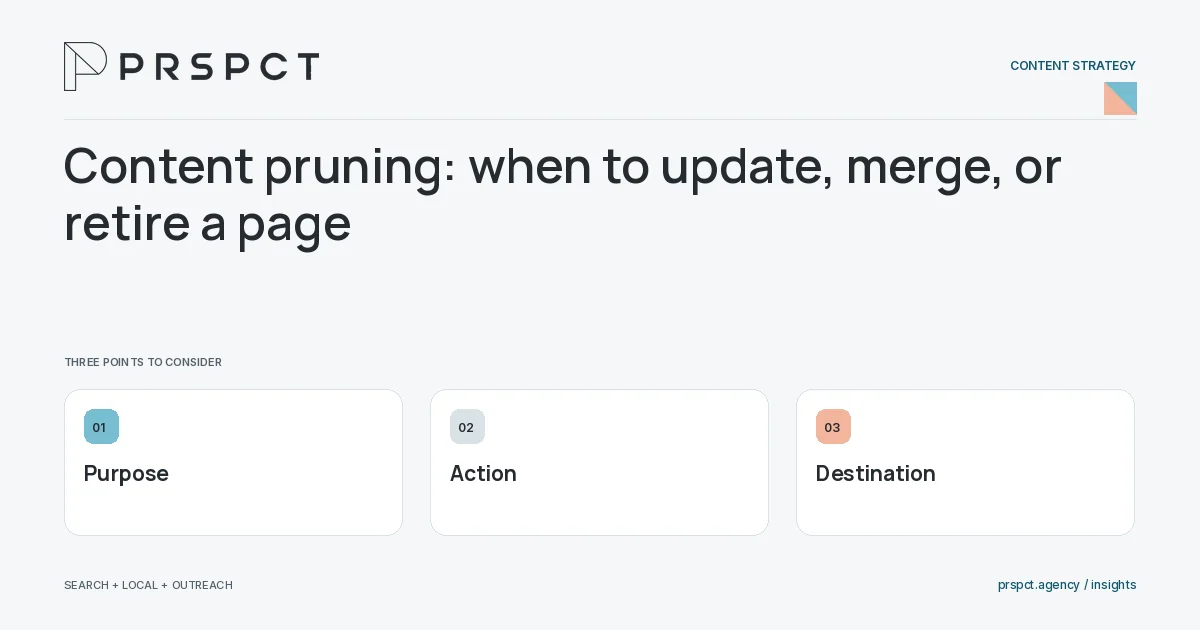
Inventory purpose
Record the intended reader, links, inquiries, and operational use. Include resources used outside search.
Choose the right action
Update stale facts, merge genuine duplicates, and retain useful niche resources. Retire pages that no longer serve a purpose.
Handle destinations
Preserve relevant links through appropriate replacements or clear retirement behavior. Update navigation and sitemaps.
A practical example
A fictional firm keeps a low-traffic onboarding checklist because prospects use it before consultations, but merges two outdated articles that answer the same question.
A decision checkpoint
Check internal and external dependencies before retiring a page. Sales may use the URL in proposals, or another useful guide may rely on its explanation. A low-traffic page can still occupy an important operational role. Choose the replacement or retirement behavior with those users in mind.
A mistake to avoid
Traffic-only deletion can remove resources that support sales or existing customers.
How to assess the result
Review the effect on important journeys and search access after changes. Keep an audit trail of decisions.
Put the work in context
A content strategy should explain why each resource belongs on the website. Useful coverage supports real customer decisions; a larger publishing calendar is not automatically a stronger one.
Maintain a topic map with the preferred URL, intended reader task, evidence, and next action. Review overlap before drafting and revisit the map when customer questions or the business offer change.
A common question
Should low-traffic pages always be deleted?
No. Consider their usefulness, audience size, links, and role in real customer decisions.
Related reading
- Content marketing for small businesses: build a useful library
- How to repurpose a blog into subscriber emails
- Topic clusters for small websites: a practical structure
- SEO reporting for small businesses: what to measure
Discuss your next priority
PRSPCT helps businesses connect search visibility, local presence, and email outreach. Email josh@prspct.agency to discuss your goals.
References and further reading
The references below support relevant platform definitions and requirements. The planning workflows and labeled examples are PRSPCT editorial guidance.