

CRM and lead qualification
What fields a small-business CRM actually needs
A useful lead record needs enough information to identify the inquiry, understand fit, assign ownership, and track the next action. Add fields only when the team uses them for a clear decision.
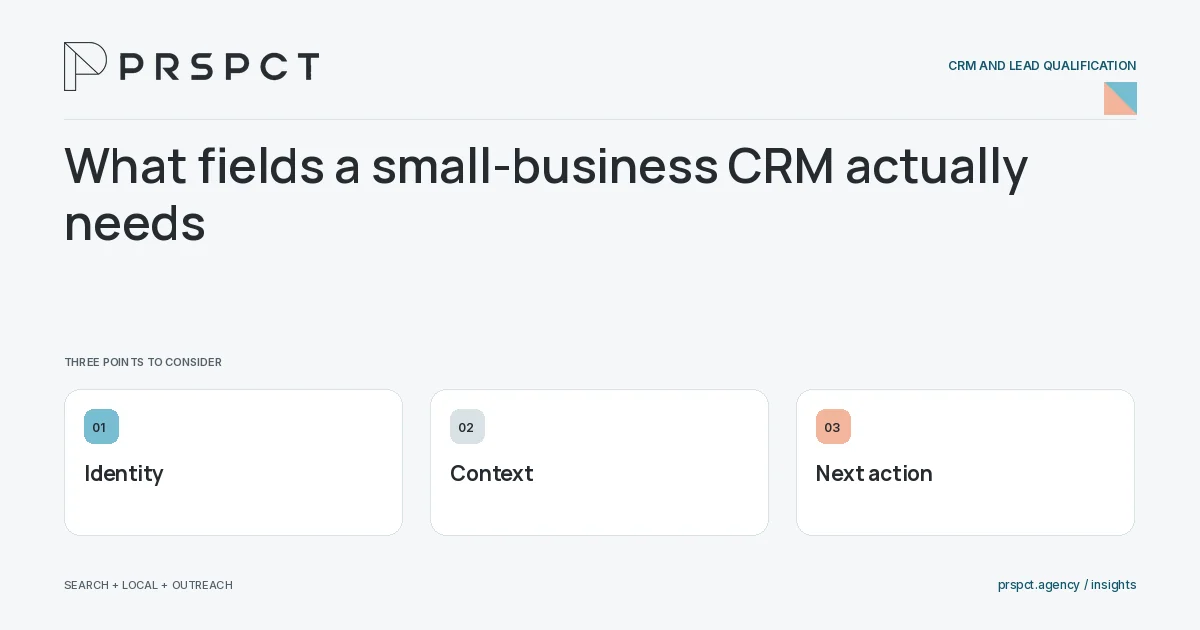
Unused mandatory fields create maintenance without insight.
Start with the workflow
Record source, request context, owner, status, and next action alongside necessary contact details.
Define allowed values
Use simple consistent categories for stages and rejection reasons.
Review necessity
Remove redundant fields and restrict sensitive information to appropriate access.
A practical example
A fictional team replaces several unused scoring fields with a clear next-action date and reason for non-fit. Records become easier to maintain and review.
A decision checkpoint
Use a field only if someone can explain the decision it supports. If it is repeatedly left blank, investigate whether the information is unavailable, unnecessary, or collected at the wrong stage. Changing the process may be better than adding another mandatory data-entry requirement.
A mistake to avoid
A CRM with more fields is not automatically a better customer process.
How to assess the result
Track completeness of decision-critical fields and whether records reliably lead to action.
Put the work in context
A small-team CRM process should make inquiry ownership and next actions visible. Begin with clear stages and reliable records rather than an elaborate scoring system nobody maintains.
Keep only information needed for the business purpose, restrict access appropriately, and avoid copying private customer details into analytics or public examples. Review stale records and missed handoffs as part of normal operations.
A common question
Should every sales note be a structured field?
No. Structure repeated decisions; use appropriate notes for context that does not fit a stable category.
Related reading
- Lead qualification process for a small business
- Lost lead reasons: turn sales feedback into better marketing
- Simple CRM pipeline stages for a service business
- Lead nurturing for small businesses: a useful strategy
Discuss your next priority
PRSPCT helps businesses connect search visibility, local presence, and email outreach. Email josh@prspct.agency to discuss your goals.
References and further reading
The references below support relevant platform definitions and requirements. The planning workflows and labeled examples are PRSPCT editorial guidance.