

CRM and lead qualification
Lead qualification process for a small business
A lead qualification process checks whether an inquiry fits the service and what next action is appropriate. Use simple criteria and consistent records so the team can distinguish fit, readiness, and validity.
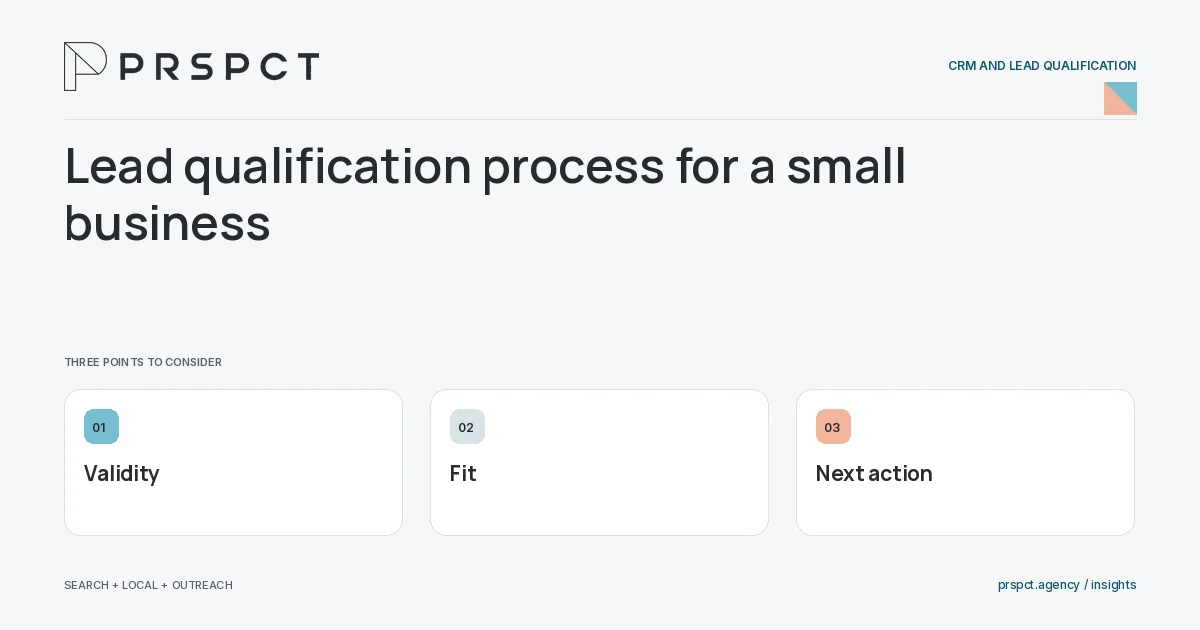
Qualification should support a useful conversation rather than create unnecessary barriers.
Confirm validity
Remove obvious spam, tests, and duplicates using documented rules.
Check fit and readiness
Record service need, practical constraints, timing, and unresolved questions.
Assign the next action
Route to a conversation, later follow-up, or clear decline with an owner.
A practical example
A fictional provider marks a suitable next-quarter project as “fit, later timing” instead of “bad lead.” The next step reflects the actual situation.
A decision checkpoint
Keep the reasons behind qualification decisions visible. A suitable prospect with an unclear requirement may need a question rather than immediate rejection. Review ambiguous cases periodically to ensure the process remains useful and does not encode unsupported assumptions about who is worth answering.
A mistake to avoid
Using one subjective score without reasons makes improvement difficult.
How to assess the result
Review qualified conversations and rejection reasons with the same definitions across sources.
Put the work in context
A small-team CRM process should make inquiry ownership and next actions visible. Begin with clear stages and reliable records rather than an elaborate scoring system nobody maintains.
Keep only information needed for the business purpose, restrict access appropriately, and avoid copying private customer details into analytics or public examples. Review stale records and missed handoffs as part of normal operations.
A common question
Should qualification happen entirely automatically?
Not necessarily. Ambiguous or valuable cases often need human judgment.
Related reading
- Simple CRM pipeline stages for a service business
- Marketing-to-sales handoff checklist
- Lead nurturing for small businesses: a useful strategy
Choose a related question
Simple CRM pipeline stages for a service business
A simple service pipeline can track new inquiry, reviewed, qualified conversation, proposal, and outcome. Use stages with clear entry rules and one responsible person rather than a large menu of ambiguous labels.
Lead routing rules for a small service team
Lead routing assigns a valid inquiry to the person able to handle its service, location, or customer context. Define a fallback owner so incomplete information does not leave requests unassigned.
Lead response workflow: what happens after an inquiry arrives?
A lead response workflow confirms receipt, assigns ownership, reviews context, and records the next action. Set a realistic internal response standard and monitor missed requests rather than publishing unsupported speed promises.
Marketing-to-sales handoff checklist
A useful handoff gives sales the inquiry source, stated need, qualification context, contact preferences, owner, and next action. Preserve the prospect’s expectations so they do not have to restart the conversation.
Lead scoring for small businesses: start simple
A simple lead score can organize fit and readiness signals, but it should support judgment rather than replace it. Use observable, relevant factors and review whether the score predicts useful conversations.
Duplicate leads in a CRM: prevent conflicting follow-up
Duplicate lead records can cause repeated messages, conflicting ownership, and inflated reporting. Define matching and merge rules that preserve useful history while avoiding incorrect combinations.
What fields a small-business CRM actually needs
A useful lead record needs enough information to identify the inquiry, understand fit, assign ownership, and track the next action. Add fields only when the team uses them for a clear decision.
Lost lead reasons: turn sales feedback into better marketing
Lost lead reasons explain why an opportunity did not progress. Separate poor fit, later timing, no response, price mismatch, and a competitor choice so the team can act on the pattern.
CRM cleanup checklist before launching a campaign
Before a campaign, review duplicates, contact status, preferences, ownership, source, and stale records. A clean audience is one the team understands and can handle appropriately, not merely a large exported file.
Discuss your next priority
PRSPCT helps businesses connect search visibility, local presence, and email outreach. Email josh@prspct.agency to discuss your goals.
References and further reading
The references below support relevant platform definitions and requirements. The planning workflows and labeled examples are PRSPCT editorial guidance.