

Digital marketing strategy
Digital marketing audit checklist for small businesses
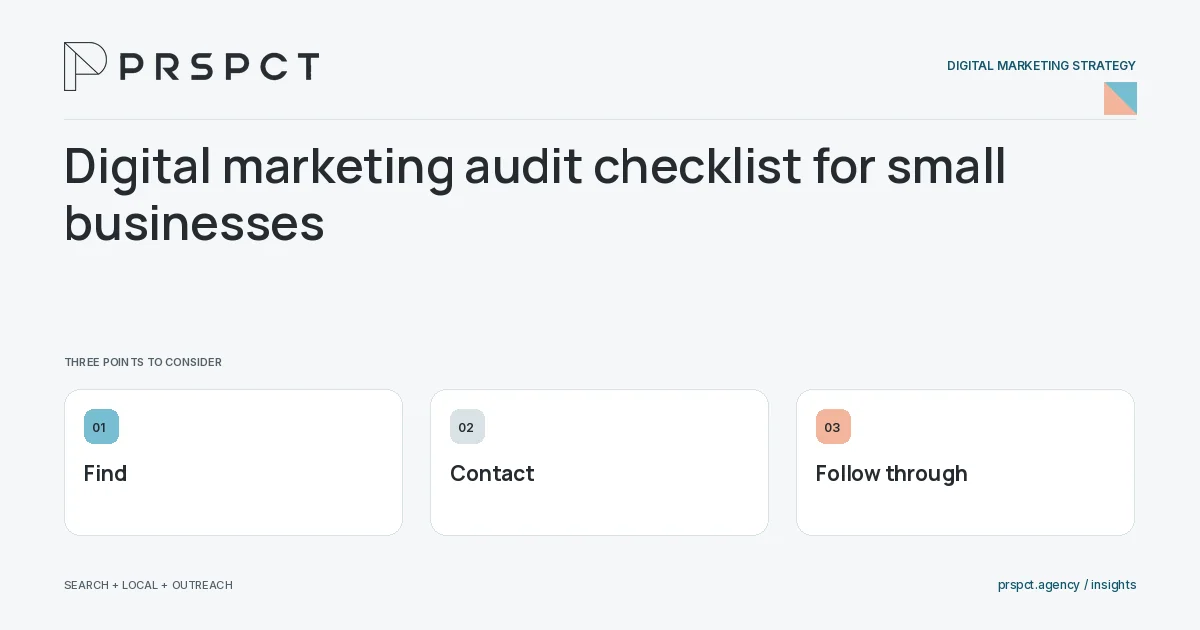
A small-business digital marketing audit checks whether customers can find the business, understand its offer, make contact, and receive a useful response. Review the entire customer path before producing a long list of disconnected channel recommendations.
The most expensive gap may be a broken form or an unanswered inbox rather than a missing campaign. Audit findings become useful when each has evidence, a business consequence, an owner, and a practical fix.
Inspect discovery surfaces
Review search listings, important website pages, and eligible local profiles. Check whether names, services, locations, and contact routes agree.
Test real conversion paths
Submit a labeled test inquiry, inspect mobile forms, and follow booking or email links. Verify receipt with the person who handles new requests.
Rank the fixes
Separate access and delivery failures from content improvements and experiments. Assign a small number of high-impact tasks with acceptance criteria.
A practical example
A fictional repair company discovers that its profile links to an old page and its mobile form hides the submit button. The first audit sprint corrects those issues, while new blog production waits until inquiries can reach the team.
A decision checkpoint
Every audit recommendation should have a completion test. “Improve the contact page” is vague; “a mobile test reaches the monitored inbox with the required service context” is reviewable. Use the same evidence standard for content recommendations by stating which customer question the revision must answer.
A mistake to avoid
Audit scores without reproducible evidence can distract the team from problems customers actually encounter.
How to assess the result
Retest the same paths after changes. Keep screenshots or test notes internally, and compare valid inquiries after the fixes with a comparable prior period.
Put the work in context
An owner-led business needs a marketing plan that fits its capacity to answer inquiries and deliver the work. A channel that creates demand faster than the team can respond can waste otherwise useful attention.
Assign one person to maintain the plan. Keep the audience, offer, channel, spending, and sales response in the same document so that a change in one area is visible to everyone responsible for the result.
A common question
How often should a small business audit its marketing?
Use a regular review cadence and repeat critical tests after a redesign, platform change, or campaign launch. The frequency should reflect how quickly the business changes.
Related reading
- Digital marketing for small businesses: a practical starting plan
- Marketing goals versus marketing metrics: what owners should track
- In-house marketing versus an agency: a decision framework
- SEO for small businesses: what to fix first
Discuss your next priority
PRSPCT helps businesses connect search visibility, local presence, and email outreach. Email josh@prspct.agency to discuss your goals.
References and further reading
The references below support relevant platform definitions and requirements. The planning workflows and labeled examples are PRSPCT editorial guidance.