

SEO foundations
SEO for small businesses: what to fix first
Small-business SEO starts with accessible pages, a clear service offer, and content that answers relevant customer questions. Fix discovery and contact problems before expanding into a large publishing program.
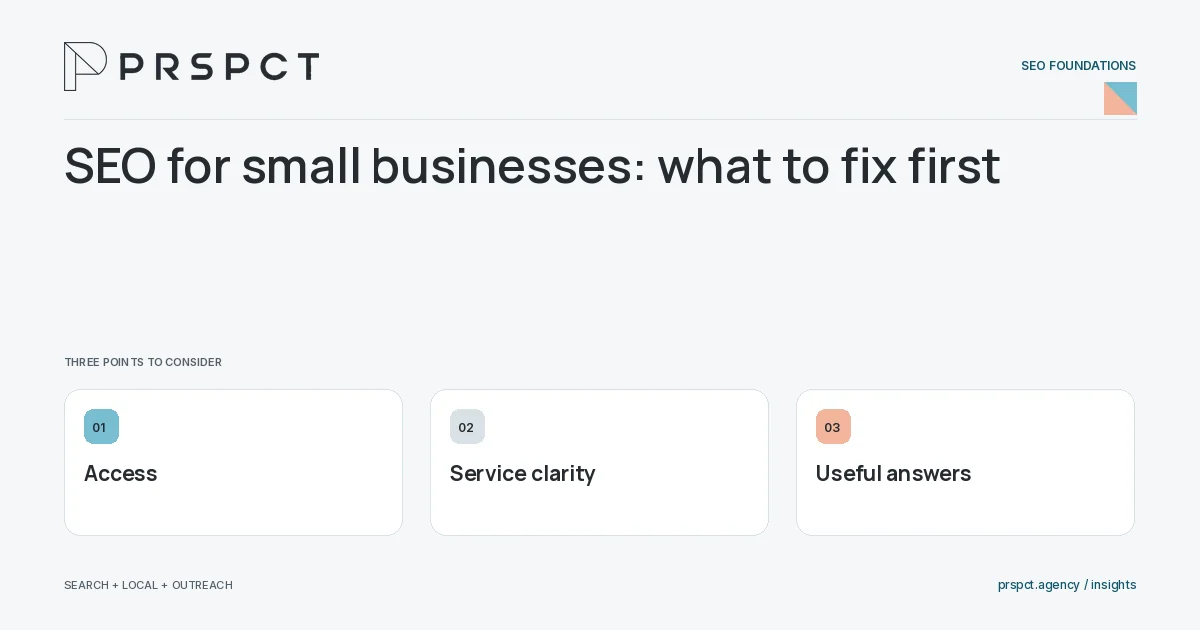
A small site does not need a complicated strategy to begin. It needs the most commercially important pages to work well.
Check access
Confirm that the main pages load, can be indexed, and have crawlable internal links. Investigate errors before rewriting copy.
Clarify core services
Give each genuinely different service a useful page explaining fit, process, boundaries, and the inquiry action.
Answer purchase questions
Use recurring customer questions to choose supporting guides. Link them to the appropriate service page without forcing a sales pitch into every paragraph.
A practical example
A fictional payroll consultant first fixes an inaccessible services page, then explains its monthly process and adds a guide to preparing payroll records. This creates a coherent path from question to service inquiry.
A decision checkpoint
When resources are limited, choose the page closest to a real customer decision and complete its whole path. A clear service explanation with a working inquiry route can be a stronger first asset than several unfinished guides. Expand after the business can maintain the pages already published.
A mistake to avoid
Publishing many articles while the core offer remains unclear creates activity without a useful destination.
How to assess the result
Review relevant impressions, landing-page visits, and qualified inquiries. Assess which queries match the service, not simply whether the total keyword count rises.
Put the work in context
Search engine optimization connects useful website information with people looking for it. For a service business, visibility is valuable when the page also makes the service, audience, and next step clear.
Keep an implementation log with the affected URL, reason for the change, and release date. Use that record when comparing search activity and sales inquiries; several changes made together are difficult to attribute individually.
A common question
Does a small business need a blog for SEO?
A blog is optional. Strong service pages and genuinely helpful supporting resources are more important than maintaining a posting habit without a purpose.
Related reading
- How long does SEO take for a new small-business website?
- Why your website gets traffic but no leads
- Keyword research for small businesses: start with buyer intent
Choose a related question
How long does SEO take for a new small-business website?
SEO has no fixed result timeline. A new website must be discovered and evaluated, and progress depends on competition, technical access, content usefulness, and demand. Separate implementation milestones from ranking and sales expectations.
SEO versus paid search for a small service business
SEO builds organic discoverability through website improvements and useful content. Paid search purchases advertising exposure. Compare them using customer intent, cash flow, conversion readiness, and the time the business can allow for learning.
SEO checklist for a new website launch
A new-website SEO checklist should cover indexability, canonical URLs, important redirects, metadata, crawlable navigation, image handling, and measurement. Test the real production environment because staging settings and preview URLs can create launch mistakes.
Why your website gets traffic but no leads
Website traffic without leads can result from irrelevant visitors, an unclear offer, weak evidence, excessive friction, or a broken contact path. Diagnose the visitor-to-inquiry journey before assuming the business simply needs more traffic.
How to choose an SEO agency without ranking promises
Choose an SEO agency by evaluating its diagnosis, proposed scope, implementation responsibility, reporting, and ability to explain tradeoffs. Ask how the work connects to your services and customers rather than selecting from ranking promises alone.
SEO for a one-page website: limits and priorities
A one-page website can explain a focused business, but it has limited room to serve distinct search intents. Prioritize one core offer and a clear contact path; add separate pages when different services or questions need substantial answers.
How to use customer questions to improve SEO
Use customer questions to identify the information buyers need before choosing a service. Record the question, the buying situation, and the answer your business can support, then decide whether to improve a service page or create a separate guide.
What an SEO maintenance plan should include
SEO maintenance keeps important pages accurate, accessible, connected, and measurable after launch. Include technical checks, offer updates, internal-link review, and evaluation of the queries and inquiries the site is receiving.
SEO terminology for business owners: a plain-language guide
SEO terms describe different stages of discovery and evaluation. Crawling means fetching a page, indexing means considering it for storage and retrieval, and ranking means ordering results for a particular search. These stages should not be treated as interchangeable.
Discuss your next priority
PRSPCT helps businesses connect search visibility, local presence, and email outreach. Email josh@prspct.agency to discuss your goals.
References and further reading
The references below support relevant platform definitions and requirements. The planning workflows and labeled examples are PRSPCT editorial guidance.