

Email copy and design
Email copywriting for small businesses: a practical framework
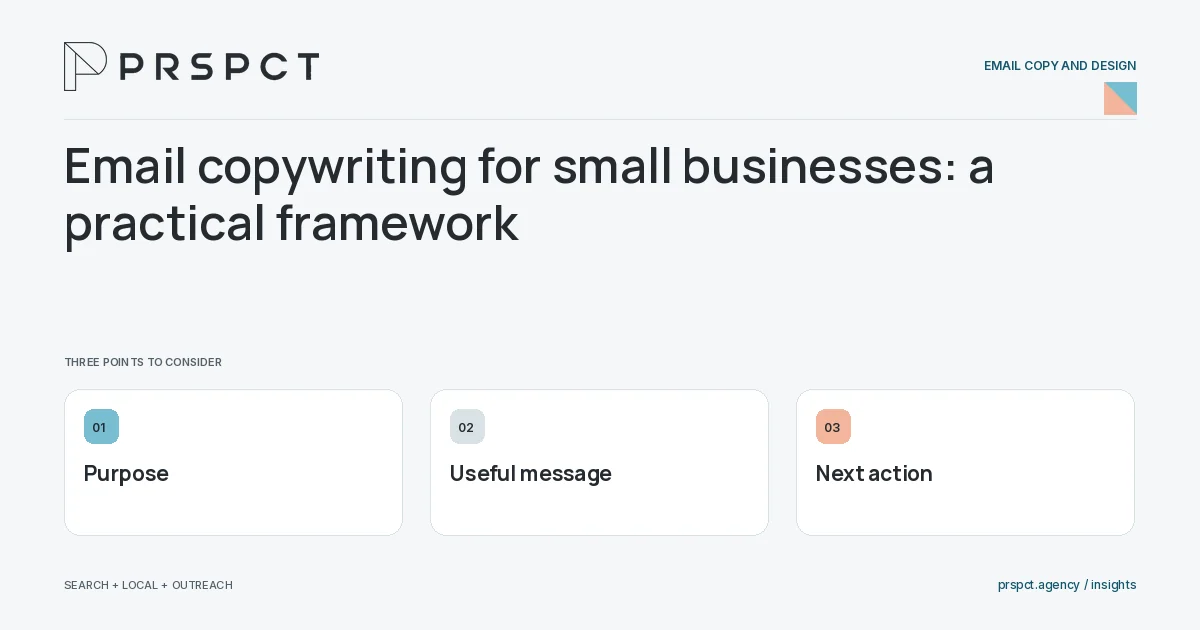
Useful email copy explains why the message matters, delivers one main idea, and offers a clear next action. Match the tone and request to what the recipient expects from the business.
A concise message still needs enough context to be understood.
Choose one job
Decide whether the email delivers, explains, announces, or asks.
Write the useful part first
Give the answer or relevant context before a lengthy introduction.
Make the action clear
Use a proportionate request and a destination that fulfills it.
A practical example
A fictional subscriber email explains one preparation mistake, shows how to avoid it, and links to the full checklist. It does not introduce three unrelated offers.
A decision checkpoint
Read the copy aloud without the design. The purpose, context, and request should remain clear. If the message only works because a graphic supplies the meaning, move the essential explanation into live text and use the visual to reinforce it rather than carry the whole argument.
A mistake to avoid
Packing several competing messages into one email can obscure the useful one.
How to assess the result
Review relevant clicks, replies, and downstream actions alongside opt-outs.
Put the work in context
Good email copy makes the subject, message, and next action agree. Write for the recipient’s relationship and task, using plain language and accurate claims rather than fabricated urgency or familiarity.
Test the message with realistic missing fields, images disabled where practical, mobile rendering, and actual link destinations. Keep essential meaning in readable text and provide an appropriate way to reply or manage preferences.
A common question
Should every email be extremely short?
Use the length needed for the task. Remove repetition while preserving useful context.
Related reading
- Email subject lines for service businesses
- Plain-text versus HTML email: choose by purpose
- Email marketing automation for small businesses
Choose a related question
Email subject lines for service businesses
A useful subject line accurately signals the message and gives the appropriate audience a reason to read. Avoid fake reply prefixes, deceptive urgency, or claims the email does not fulfill.
Preview text for email newsletters: what to write
Preview text supports the subject by adding useful context rather than repeating it. Write it intentionally so inboxes do not fill the space with navigation, code fragments, or an unrelated footer.
Email calls to action: choose one useful next step
An email CTA should tell the reader what happens next and match the message’s purpose. Choose a primary action that fits the relationship rather than asking every reader to book immediately.
Plain-text versus HTML email: choose by purpose
Plain-text and HTML email offer different presentation options. Choose the format that communicates the message clearly, renders reliably, and supports accessibility and tracking needs without assuming one always delivers better.
How to personalize marketing emails without sounding artificial
Useful personalization reflects relevant information the business genuinely knows and can use appropriately. Adapt the message to the audience’s needs rather than inserting a name into an otherwise irrelevant pitch.
Email design checklist for a professional service business
Professional email design uses readable type, clear hierarchy, useful links, and restrained branding. Keep essential information in text and test the message in realistic reading conditions.
Email accessibility checks beyond the visual preview
Accessible email uses readable structure, meaningful text, descriptive links, and sensible image handling. Test whether the message’s purpose remains understandable beyond a single visual inbox preview.
How to write useful newsletter introductions
A useful newsletter introduction quickly explains the topic and why it matters to the subscriber. Begin with the decision or problem rather than a long update about the sender.
Email copy review checklist before approval
Review email copy for audience fit, accuracy, clarity, promise fulfillment, personalization, and next-step handling. Read it as the recipient would experience it, including the subject, preview, body, destination, and reply route.
Discuss your next priority
PRSPCT helps businesses connect search visibility, local presence, and email outreach. Email josh@prspct.agency to discuss your goals.
References and further reading
The references below support relevant platform definitions and requirements. The planning workflows and labeled examples are PRSPCT editorial guidance.