

On-page SEO
H1, H2, and H3 headings: a practical website structure
Use an H1 to identify the page’s main subject, H2 headings for major sections, and H3 headings for subsections. The hierarchy should reflect the content rather than the font size you want.
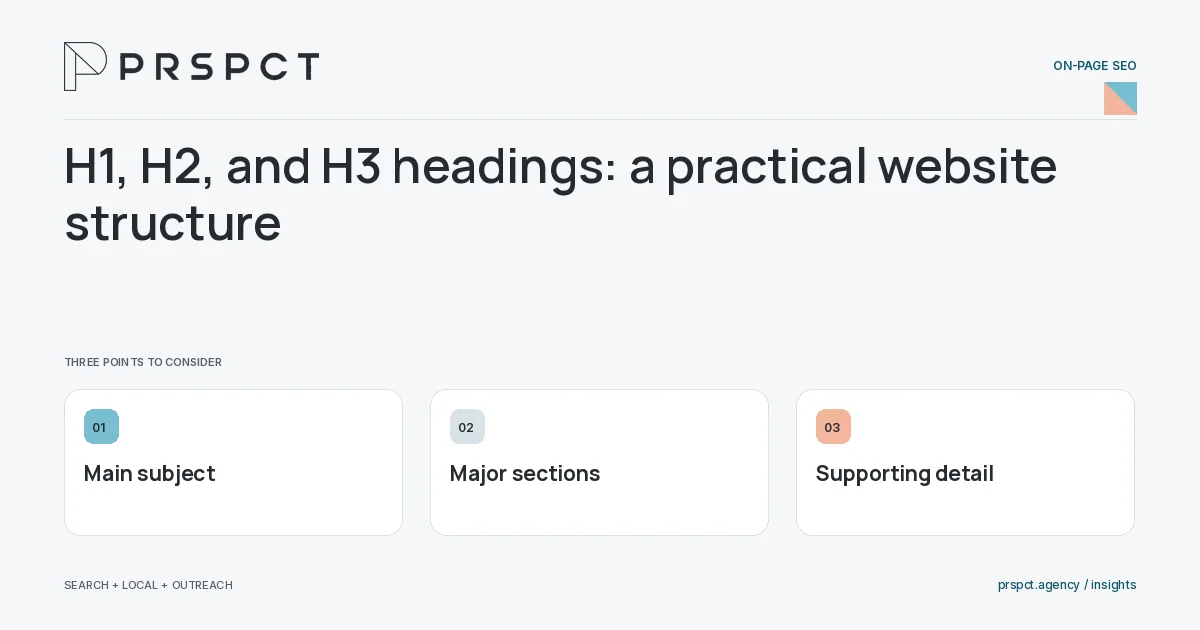
Clear headings help readers understand where they are and what each section answers.
Choose one main subject
Write a descriptive H1 matching the page purpose. A single clear H1 is a useful editorial convention.
Group related sections
Use H2 headings for distinct decisions such as fit, process, and preparation. Nest details under the appropriate section.
Separate style from meaning
Use CSS to control appearance. Do not select heading levels merely because a particular default size looks good.
A practical example
A fictional service guide uses one H1, H2 sections for eligibility and preparation, and H3 subsections for specific documents. Readers can scan the hierarchy without reading every paragraph.
A decision checkpoint
A heading outline should make sense without the paragraphs underneath it. Read the H1 and section headings in order and ask whether they describe a coherent explanation. Then inspect whether each section fulfills its heading; a clean hierarchy cannot rescue a section that answers a different question.
A mistake to avoid
Using bold text as the only section structure makes relationships less clear to assistive technology and readers.
How to assess the result
Inspect the rendered heading outline and test narrow-screen scanning. Confirm that headings accurately describe the material that follows.
Put the work in context
On-page SEO should make a page easier to identify, understand, and use. Align titles, headings, copy, images, and internal links with the same reader task rather than optimizing each element in isolation.
Before changing a page, write its purpose in one sentence. Use that sentence to check whether every major section contributes to the answer and whether the next step follows naturally from the information provided.
A common question
Does using one H1 guarantee better rankings?
No. It is a practical clarity convention, not a standalone ranking guarantee.
Related reading
- On-page SEO checklist for a small-business service page
- Internal linking for small websites: a useful page map
- How to optimize an existing blog without keyword stuffing
- Technical SEO checklist for a small website
Discuss your next priority
PRSPCT helps businesses connect search visibility, local presence, and email outreach. Email josh@prspct.agency to discuss your goals.
References and further reading
The references below support relevant platform definitions and requirements. The planning workflows and labeled examples are PRSPCT editorial guidance.