

On-page SEO
On-page SEO checklist for a small-business service page
On-page SEO for a service page combines a clear topic, useful buying information, descriptive metadata, accessible content, and relevant links. Prioritize what helps a prospective customer understand whether the service fits.
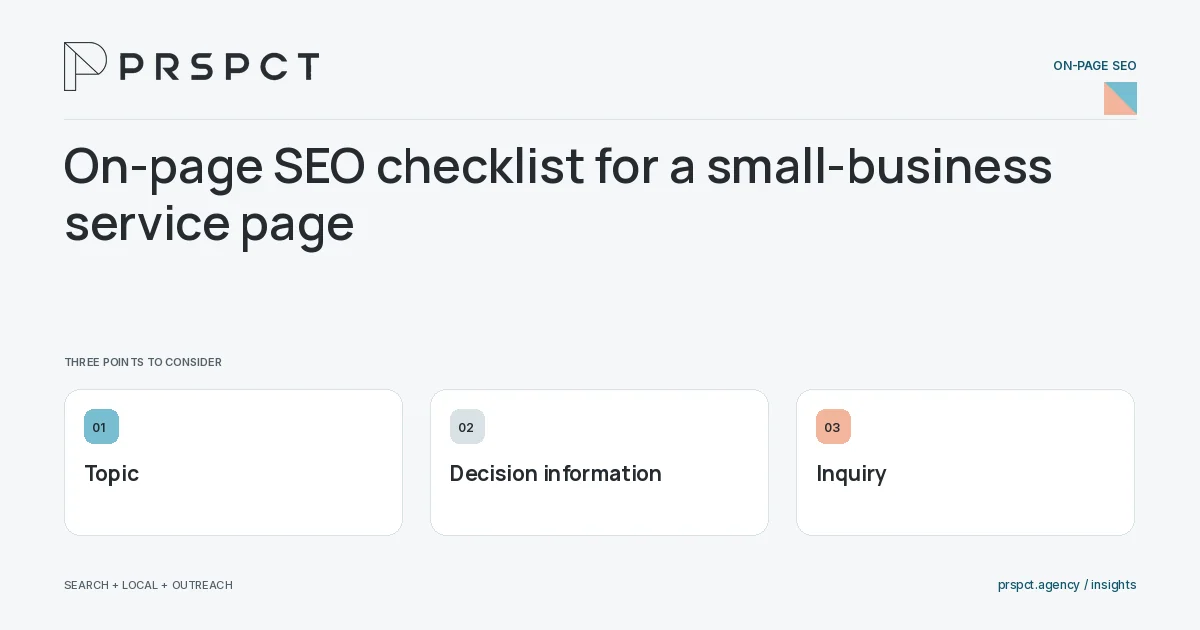
A technically polished page still needs a specific offer and a credible next step.
Define the page
Name the service, audience, and scope early. Avoid vague hero copy that requires visitors to infer what the business does.
Answer the buying questions
Explain process, preparation, boundaries, and evidence the business can support. Use meaningful headings for scanning.
Connect the journey
Add relevant internal links and a working inquiry action. Write metadata that accurately describes the visible page.
A practical example
A fictional commercial cleaning page explains facility types, assessment steps, and quote preparation. A related checklist supports planning, while the inquiry form asks for enough detail to route the request.
A decision checkpoint
Read the page from the perspective of a suitable first-time customer. They should know what is included, what they need to prepare, and how to begin. If those answers require a call merely to understand the basic offer, improve them before adding more promotional sections or keywords.
A mistake to avoid
Repeating the target phrase in every heading makes the page harder to read without improving its purpose.
How to assess the result
Review relevant search queries, valid inquiries, and whether prospects understand the scope before contacting the business.
Put the work in context
On-page SEO should make a page easier to identify, understand, and use. Align titles, headings, copy, images, and internal links with the same reader task rather than optimizing each element in isolation.
Before changing a page, write its purpose in one sentence. Use that sentence to check whether every major section contributes to the answer and whether the next step follows naturally from the information provided.
A common question
Does every heading need the primary keyword?
No. Headings should describe their sections naturally. Topic clarity matters more than mechanical repetition.
Related reading
- How to write SEO title tags for service businesses
- Internal linking for small websites: a useful page map
- Technical SEO checklist for a small website
Choose a related question
How to write SEO title tags for service businesses
A service-page title should identify the service and a useful differentiator, with the business name when space allows. It must accurately match the page rather than promise an outcome the content cannot support.
Meta descriptions that explain the next step
A useful meta description summarizes the page, identifies relevant fit, and explains what a reader can do next. Write a distinct description for important pages without treating it as a guaranteed search snippet.
H1, H2, and H3 headings: a practical website structure
Use an H1 to identify the page’s main subject, H2 headings for major sections, and H3 headings for subsections. The hierarchy should reflect the content rather than the font size you want.
Internal linking for small websites: a useful page map
Internal links connect related pages so readers and crawlers can discover useful destinations. Use descriptive links where the next page genuinely helps with the current task.
Image SEO for business blogs: filenames, alt text, and loading
Image SEO combines relevant visuals, descriptive filenames, appropriate alternative text, accessible rendering, and sensible file size. Keep important explanations in live text so the image supports the answer rather than containing the only answer.
SEO-friendly URLs: how to name pages and blog posts
An SEO-friendly URL is readable, stable, and descriptive of the page’s topic. Use a consistent structure and avoid changing established URLs solely to insert extra keywords.
How to optimize an existing blog without keyword stuffing
Improve an existing blog by checking intent, missing decisions, accuracy, structure, and links. Add the information readers need rather than increasing keyword repetition to hit an arbitrary density target.
Service page versus blog post: where should a keyword go?
Use a service page when the reader is evaluating a provider or offer. Use a blog or guide when the task is learning, preparing, or comparing in a way that needs an independent explanation.
SEO content briefs: what to give a writer before drafting
An SEO content brief defines the reader task, primary intent, boundaries, evidence, structure, and next step. It should guide an original answer without prescribing repetitive keyword placement.
Discuss your next priority
PRSPCT helps businesses connect search visibility, local presence, and email outreach. Email josh@prspct.agency to discuss your goals.
References and further reading
The references below support relevant platform definitions and requirements. The planning workflows and labeled examples are PRSPCT editorial guidance.