

Lead generation strategy
Lead generation for small businesses: build the full path
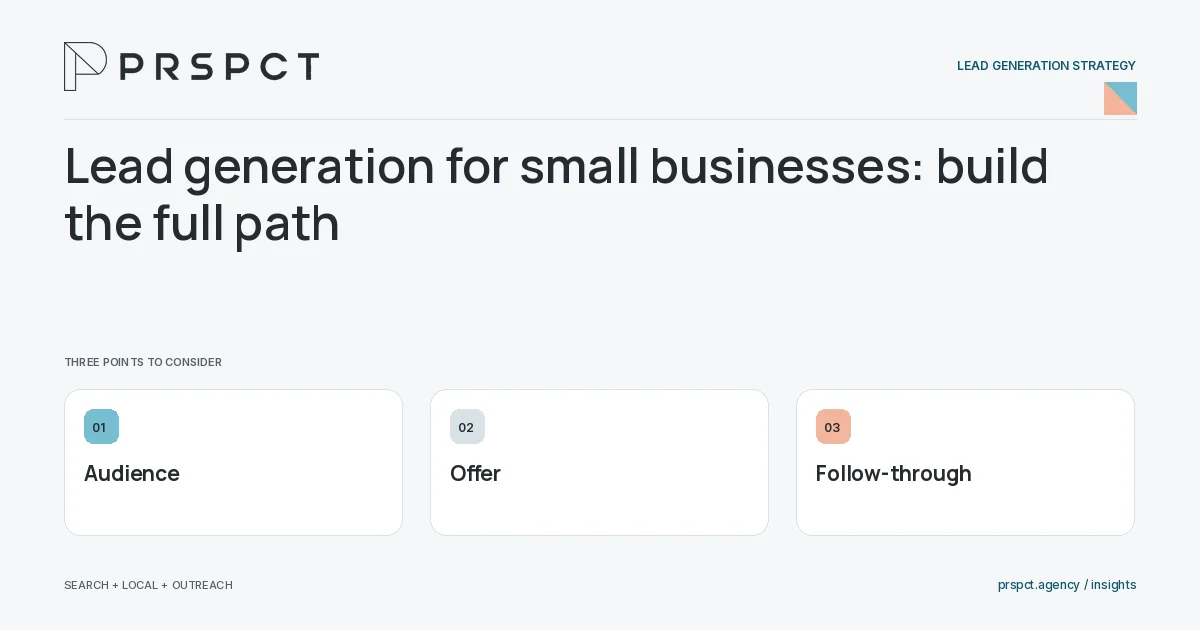
Lead generation creates opportunities for relevant prospects to contact a business. Build the path from audience and offer through inquiry, qualification, and follow-up rather than focusing only on traffic or form volume.
A lead has little value if the business cannot recognize or respond to it.
Define the audience
Choose a customer situation and service the business can actually support.
Create a useful offer
Explain the value and next step on a focused page. Ask for information needed to respond.
Assign follow-through
Name the reply owner and qualification process. Test real delivery before sending traffic.
A practical example
A fictional consultant publishes a readiness guide tied to an assessment offer. Interested readers can request a conversation, and the owner records fit and next action.
A decision checkpoint
Define what happens when an inquiry is unsuitable. A clear decline, referral where appropriate, or request for clarification can close the loop respectfully. Leaving every non-fit request unanswered creates operational ambiguity and weakens the record used to assess campaign quality.
A mistake to avoid
Counting every contact record as a qualified lead blurs the business outcome.
How to assess the result
Track valid inquiries, fit, conversations, and customers with stable definitions.
Put the work in context
Lead generation should connect a relevant audience with a useful offer and a reliable response. More submissions are valuable only when the business can identify suitable inquiries and follow through.
Define the inquiry, qualification, and handoff before launching a campaign. Keep the source, owner, status, and next action visible so that marketing activity does not end at an unmonitored inbox.
A common question
Is lead generation the same as sales?
No. It creates and develops opportunities; sales evaluates and closes suitable work, often with an overlapping handoff.
Related reading
- Inbound versus outbound lead generation: how they differ
- Gated versus ungated content for lead generation
- Lead capture forms: a practical design checklist
Choose a related question
Inbound versus outbound lead generation: how they differ
Inbound lead generation attracts people through useful discovery experiences, while outbound initiates contact with selected prospects. They require different audience assumptions, messaging, permissions, and operational processes.
Lead generation funnel for a service business
A service-business lead funnel describes stages from relevant attention to valid inquiry, qualified conversation, proposal, and customer. Use it to locate handoff failures rather than assume every stage moves at a fixed rate.
Lead magnet ideas for a service business
Useful service-business lead magnets help a relevant audience complete a preparation or evaluation task. Choose a checklist, worksheet, or decision guide that connects naturally to the service without withholding basic clarity.
Gated versus ungated content for lead generation
Gated content requires information before access; ungated content is available directly. Choose based on resource value, audience expectations, discoverability, and what the business will do with the information collected.
How to define a qualified lead for a service business
A qualified lead meets agreed requirements for service fit and has enough context for a useful next conversation. Separate fit from timing, and define criteria before comparing campaigns.
Lead generation offer examples beyond a generic free consultation
A lead-generation offer should make the first step useful and specific. An assessment, planning worksheet, fit conversation, or scoped review can work when the business can explain what the prospect receives and what happens next.
Lead generation without paid ads: where to start
Lead generation without paid ads can use useful search content, accurate local presence, permissioned email, referrals, and genuine partnerships. Select a maintainable path connected to a clear offer and response process.
Why lead generation campaigns attract the wrong customers
Wrong-fit leads often reflect unclear scope, mismatched audience intent, overly broad offers, or weak qualification. Use rejection reasons to diagnose the mismatch before reducing all campaign activity.
Lead generation campaign brief: a usable checklist
A lead-generation brief should define audience, problem, offer, destination, qualification, response owner, and measurement. It gives everyone the same view of what the campaign is meant to create.
Discuss your next priority
PRSPCT helps businesses connect search visibility, local presence, and email outreach. Email josh@prspct.agency to discuss your goals.
References and further reading
The references below support relevant platform definitions and requirements. The planning workflows and labeled examples are PRSPCT editorial guidance.