

Digital marketing strategy
How to write a marketing brief an agency can use
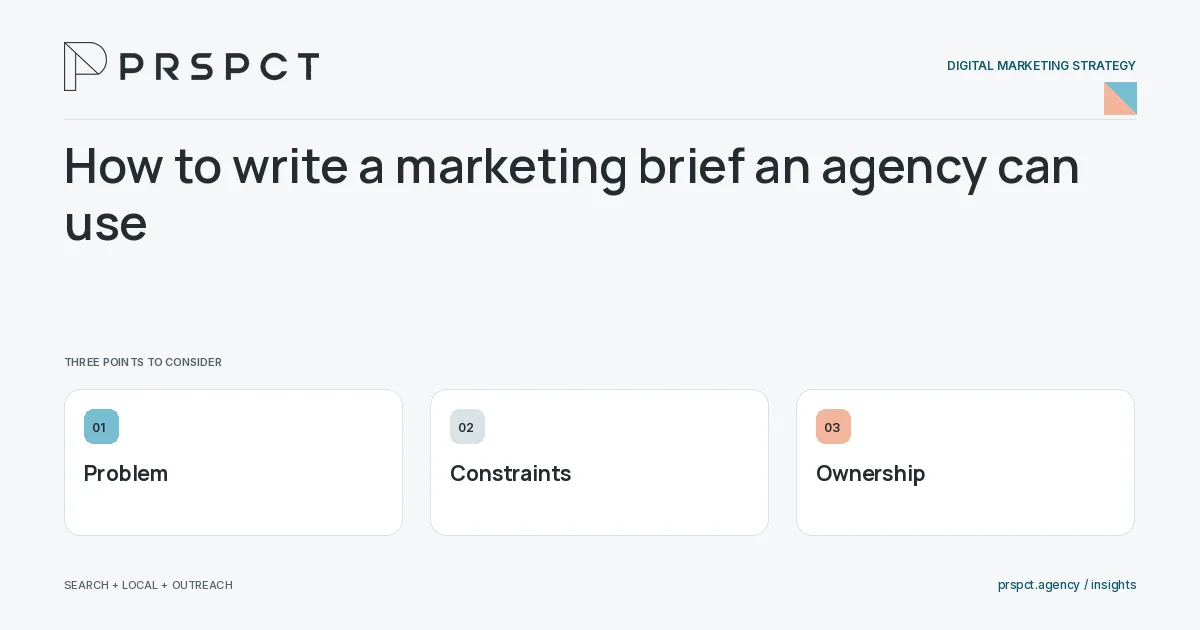
A useful marketing brief states the business problem, target audience, offer, constraints, existing assets, and definition of success. It gives an agency enough context to recommend scope without requiring the owner to prescribe every tactic.
An instruction such as “get more leads” leaves important decisions unresolved. The brief should show what a suitable lead looks like and what happens once that person responds.
Describe the commercial situation
Explain the service, customer problem, capacity, and current sources of business. Include the offers or markets you do not want to promote.
Share evidence and constraints
Provide relevant analytics access, customer questions, approved claims, brand assets, and budget boundaries. Label assumptions separately from verified facts.
Define ownership and review
Name the approver, reply owner, sales handoff, and review cadence. Ask for proposed deliverables and acceptance criteria.
A practical example
A fictional facilities company briefs an agency to increase quote requests for recurring contracts in its actual service area. It shares approved service descriptions and names the operations manager as the person who qualifies incoming inquiries.
A decision checkpoint
Include non-goals in the brief. Naming services, audiences, or claims that should not appear can prevent expensive rework. Keep the exclusions specific and explain whether they reflect current capacity, strategic choice, or an unresolved decision so the agency knows which assumptions it may revisit.
A mistake to avoid
A brief that lists only desired channels can lead to a polished campaign aimed at the wrong commercial problem.
How to assess the result
Check proposals against the brief: audience, scope, responsibilities, measurement, and exclusions should be explicit. Resolve contradictions before production begins.
Put the work in context
An owner-led business needs a marketing plan that fits its capacity to answer inquiries and deliver the work. A channel that creates demand faster than the team can respond can waste otherwise useful attention.
Assign one person to maintain the plan. Keep the audience, offer, channel, spending, and sales response in the same document so that a change in one area is visible to everyone responsible for the result.
A common question
Does a marketing brief need to include a final strategy?
No. It should establish the business context and decision boundaries so the strategy can be developed from evidence.
Related reading
- Digital marketing for small businesses: a practical starting plan
- In-house marketing versus an agency: a decision framework
- How to choose a marketing channel for a service business
- SEO for small businesses: what to fix first
Discuss your next priority
PRSPCT helps businesses connect search visibility, local presence, and email outreach. Email josh@prspct.agency to discuss your goals.
References and further reading
The references below support relevant platform definitions and requirements. The planning workflows and labeled examples are PRSPCT editorial guidance.