

On-page SEO
How to write SEO title tags for service businesses
A service-page title should identify the service and a useful differentiator, with the business name when space allows. It must accurately match the page rather than promise an outcome the content cannot support.
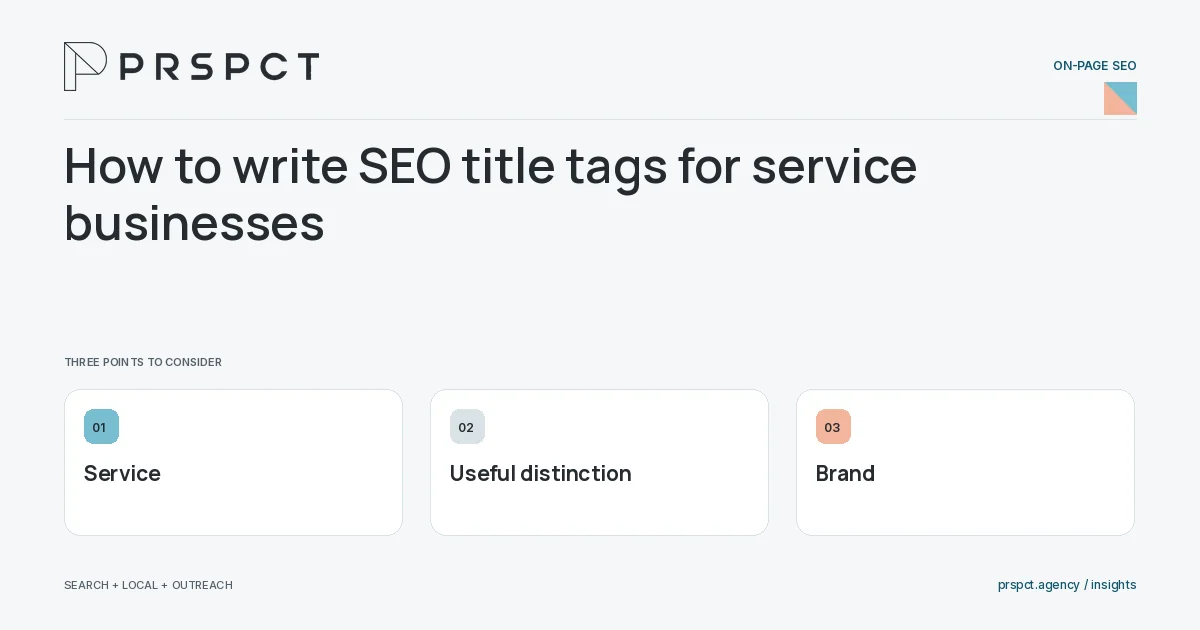
The title is a summary of the destination, not a place to store every keyword.
Lead with the subject
Put the recognizable service or question early. Add location only when the page genuinely serves a local intent.
Use supported detail
Choose a real audience, process, or scope distinction instead of unsupported superlatives.
Check consistency
Compare the title with the H1 and visible copy. Search engines can display a different title, so treat your tag as an input.
A practical example
Illustrative title: “Monthly bookkeeping for small teams | Example Firm.” It is more informative than “Best affordable top bookkeeping services and accounting help.”
A decision checkpoint
Preserve a record of the previous title when testing a revision. If search exposure changes, the old wording helps the team understand what was altered. Also note other page and campaign changes during the period so a click-through difference is not automatically attributed to the title alone.
A mistake to avoid
Forcing every variant into one tag creates an unreadable title and may obscure the main service.
How to assess the result
Review query relevance and click-through alongside position and result context. A title change is not a controlled ranking experiment by itself.
Put the work in context
On-page SEO should make a page easier to identify, understand, and use. Align titles, headings, copy, images, and internal links with the same reader task rather than optimizing each element in isolation.
Before changing a page, write its purpose in one sentence. Use that sentence to check whether every major section contributes to the answer and whether the next step follows naturally from the information provided.
A common question
Is there a strict 60-character title limit?
No universal character count guarantees display. Keep titles concise and inspect real previews without treating a length target as a rule.
Related reading
- On-page SEO checklist for a small-business service page
- Meta descriptions that explain the next step
- Image SEO for business blogs: filenames, alt text, and loading
- Technical SEO checklist for a small website
Discuss your next priority
PRSPCT helps businesses connect search visibility, local presence, and email outreach. Email josh@prspct.agency to discuss your goals.
References and further reading
The references below support relevant platform definitions and requirements. The planning workflows and labeled examples are PRSPCT editorial guidance.