

Content strategy
Editorial quality checklist before publishing a business blog
An editorial quality check confirms that a post answers a distinct question, supports factual claims, gives useful examples, and works as a complete page. Metadata and schema should accurately describe that finished content.
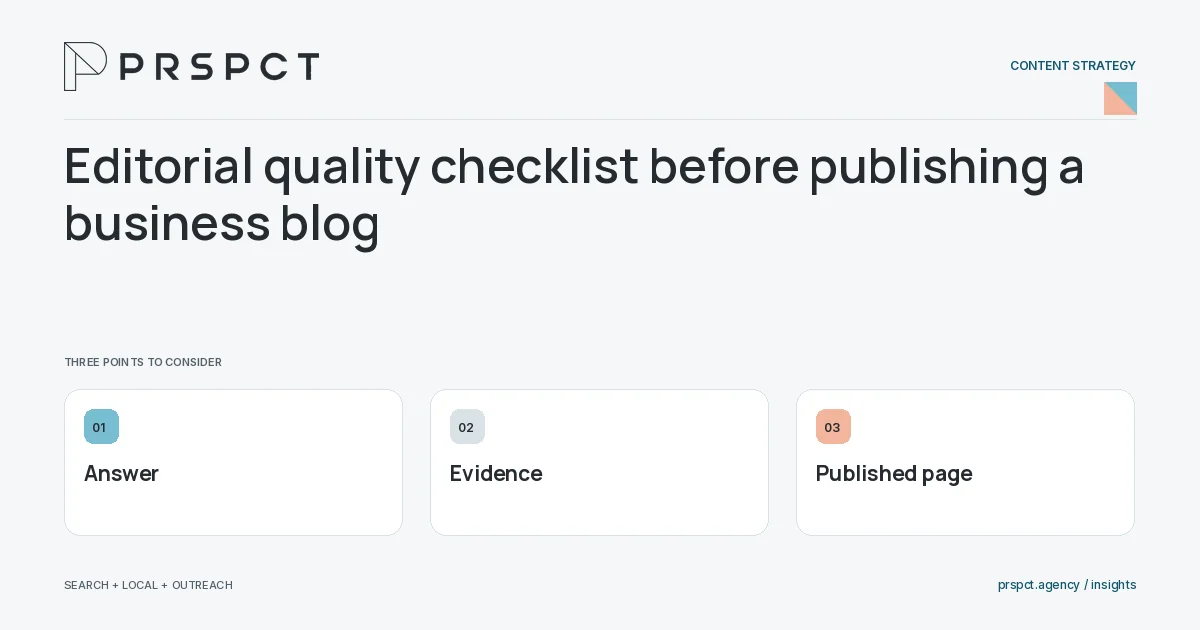
A technically valid page can still offer a weak answer.
Read for decision value
Check that the opening answers the question and the body explains how to apply it.
Verify evidence and boundaries
Review sources, hypothetical labels, business claims, and overlap with existing pages.
Inspect the published form
Check heading order, links, image descriptions, metadata, structured data, and the contact destination.
A practical example
A fictional reviewer notices that a guide recommends a process without explaining when not to use it. Adding the tradeoff improves usefulness more than adding another keyword variation.
A decision checkpoint
Ask a reviewer to identify the article’s contribution in one sentence. If they cannot say what a reader gains beyond a generic definition, the draft may need a more specific example or decision boundary. Check usefulness before spending time polishing decorative details.
A mistake to avoid
Treating automated checks as a substitute for reading the article misses factual and editorial problems.
How to assess the result
Use a sign-off record with owner and revision date. Recheck time-sensitive platform claims before release.
Put the work in context
A content strategy should explain why each resource belongs on the website. Useful coverage supports real customer decisions; a larger publishing calendar is not automatically a stronger one.
Maintain a topic map with the preferred URL, intended reader task, evidence, and next action. Review overlap before drafting and revisit the map when customer questions or the business offer change.
A common question
Can a quality checklist guarantee rankings?
No. It improves the work under your control without guaranteeing how search engines or customers respond.
Related reading
- Content marketing for small businesses: build a useful library
- How to refresh outdated blog content without changing its purpose
- SEO reporting for small businesses: what to measure
Discuss your next priority
PRSPCT helps businesses connect search visibility, local presence, and email outreach. Email josh@prspct.agency to discuss your goals.
References and further reading
The references below support relevant platform definitions and requirements. The planning workflows and labeled examples are PRSPCT editorial guidance.