

Content strategy
How to refresh outdated blog content without changing its purpose
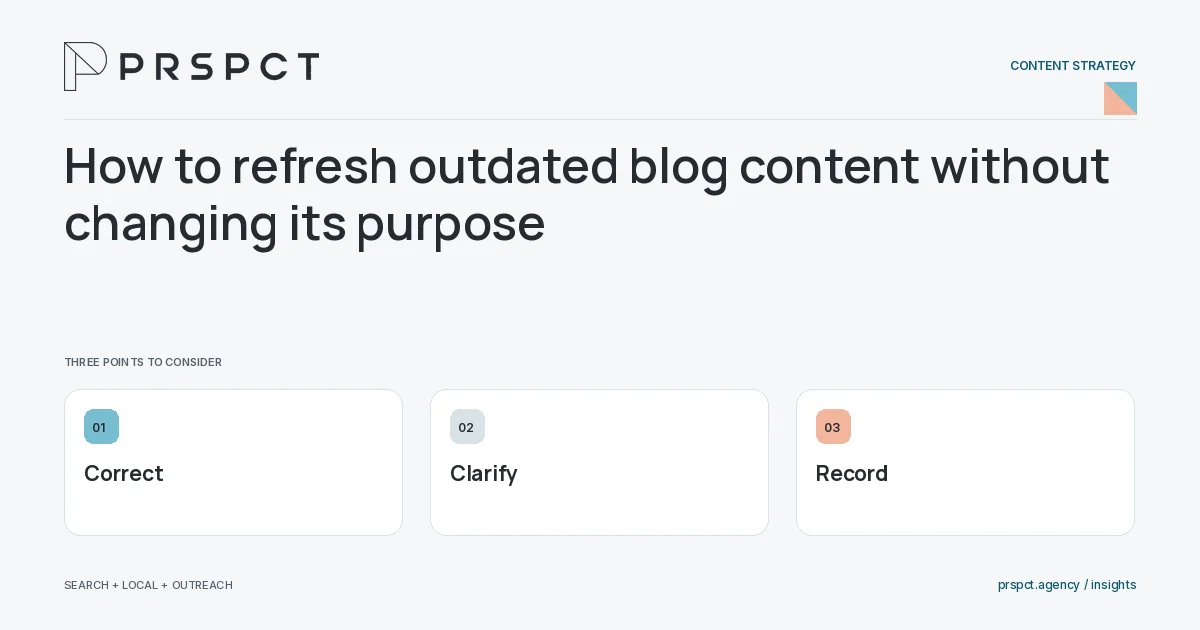
Refresh an old post by correcting changed facts, improving unclear answers, and updating examples or links. Preserve a stable URL when the reader task remains the same, and change dates only to reflect real editorial work.
Freshness should describe substantive usefulness rather than a cosmetic timestamp.
Check factual changes
Review platform behavior, service details, references, and broken destinations. Remove claims no longer supported.
Improve the weak decision
Use reader or sales questions to identify what the article still fails to explain.
Record the revision
Document meaningful changes and inspect metadata, images, and related links after the update.
A practical example
A fictional form guide replaces an obsolete integration example and adds a clear failure-state test. Its URL remains stable because the original task is unchanged.
A decision checkpoint
Check linked resources during the refresh. An accurate article can still send readers to a retired download or an irrelevant service page. Updating those paths is a substantive improvement, and it should be included in the revision record rather than treating the task as text editing alone.
A mistake to avoid
Adding a current year while leaving stale advice intact can mislead readers.
How to assess the result
Review query relevance and whether the revised guide reduces confusion. Allow time for comparable observations.
Put the work in context
A content strategy should explain why each resource belongs on the website. Useful coverage supports real customer decisions; a larger publishing calendar is not automatically a stronger one.
Maintain a topic map with the preferred URL, intended reader task, evidence, and next action. Review overlap before drafting and revisit the map when customer questions or the business offer change.
A common question
Should every refreshed post get a new URL?
Usually not when the intent is unchanged. A new URL needs a practical reason and a migration plan.
Related reading
- Content marketing for small businesses: build a useful library
- Content gap analysis using sales and support questions
- Content pruning: when to update, merge, or retire a page
- SEO reporting for small businesses: what to measure
Discuss your next priority
PRSPCT helps businesses connect search visibility, local presence, and email outreach. Email josh@prspct.agency to discuss your goals.
References and further reading
The references below support relevant platform definitions and requirements. The planning workflows and labeled examples are PRSPCT editorial guidance.