

Content strategy
Case study versus illustrative example: honest marketing content
A case study reports a real, supportable situation and outcome; an illustrative example explains a method using invented or generalized details. Label examples clearly and reserve results claims for evidence you can verify and publish.
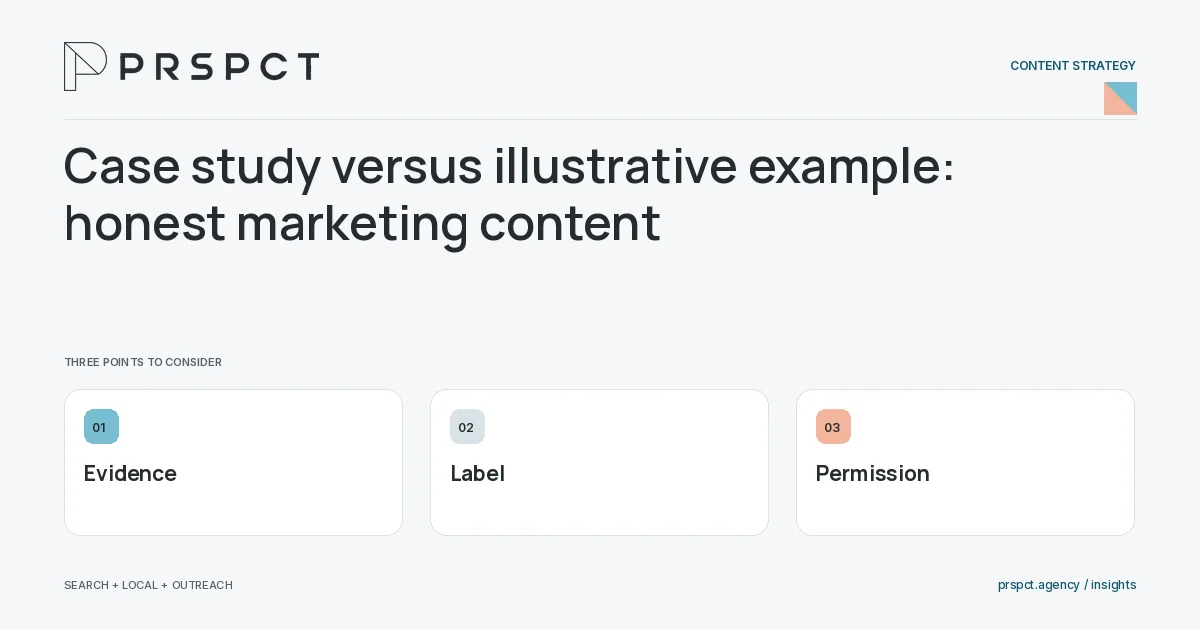
Readers need to know whether numbers describe an actual client result.
Identify the evidence
Collect approved facts, dates, scope, and measurement limits for a real case. Do not infer missing results.
Label illustrations
Use clear wording when a scenario or calculation is hypothetical. Avoid implying it happened to a client.
Explain attribution limits
Describe other changes or constraints that affect interpretation. Obtain permission for identifying details.
A practical example
An article might show a fictional 100-inquiry funnel to explain conversion arithmetic. It should not call that scenario a PRSPCT client success story.
A decision checkpoint
Keep hypothetical arithmetic visually close to its assumptions. A reader should not encounter an impressive percentage and discover much later that the numbers were invented. Labels should travel with the example when it is repurposed into a graphic, email, or presentation.
A mistake to avoid
Invented testimonials or unlabeled synthetic results create false evidence.
How to assess the result
Check every outcome claim against its source and permission before publication. Keep the supporting record internally.
Put the work in context
A content strategy should explain why each resource belongs on the website. Useful coverage supports real customer decisions; a larger publishing calendar is not automatically a stronger one.
Maintain a topic map with the preferred URL, intended reader task, evidence, and next action. Review overlap before drafting and revisit the map when customer questions or the business offer change.
A common question
Can an example still be useful without real client data?
Yes. A clearly labeled example can explain a decision without pretending to prove performance.
Related reading
- Content marketing for small businesses: build a useful library
- Content pruning: when to update, merge, or retire a page
- SEO reporting for small businesses: what to measure
Discuss your next priority
PRSPCT helps businesses connect search visibility, local presence, and email outreach. Email josh@prspct.agency to discuss your goals.
References and further reading
The references below support relevant platform definitions and requirements. The planning workflows and labeled examples are PRSPCT editorial guidance.