

Keyword research
How to find content opportunities from competitor websites
A competitor content review finds customer questions your website does not yet answer well. Compare services and intent before treating every competitor keyword as an opportunity.
A competitor may serve different locations, budgets, or customer types.
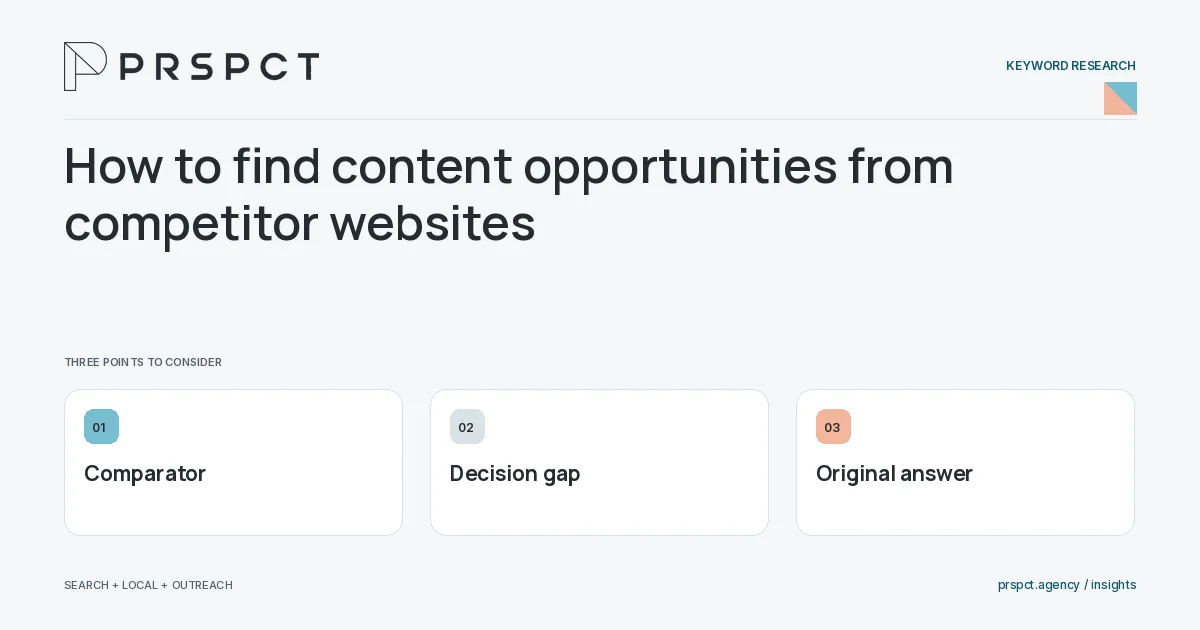
Choose relevant comparators
Select businesses addressing similar buyers and services, rather than only the largest industry websites.
Review decision coverage
Compare explanations of process, fit, preparation, alternatives, and limitations. Note gaps that matter to your customers.
Write an original angle
Use your own structure and examples. Create a better answer to the decision rather than copying wording or page inventories.
A practical example
A fictional onboarding consultant notices that competitors discuss software but rarely explain who should own internal approvals. It creates an original responsibility checklist tied to that neglected decision.
A decision checkpoint
Consider why the competitor has the page. It may support a service or market you do not offer, or its visibility may depend on a broader site history. Use the comparison to sharpen your own decisions rather than assuming that reproducing the inventory will reproduce the outcome.
A mistake to avoid
Copying competitors’ topics wholesale can import their irrelevant audiences and overlap problems.
How to assess the result
Validate proposed topics against actual results and customer questions. Record why each gap belongs in your plan.
Put the work in context
Keyword research is most useful when it explains a customer decision. A short phrase can represent several different needs, while a longer query may identify a specific problem that the business can answer well.
Keep one primary intent for each planned page. Record close variants together, inspect the current results, and assign the topic to an existing URL whenever that page already serves the same decision.
A common question
Should a business copy a successful competitor’s content?
No. Use the review to identify unanswered needs and create original, supportable material for your own audience.
Related reading
- Keyword research for small businesses: start with buyer intent
- Branded versus non-branded keywords in SEO reporting
- On-page SEO checklist for a small-business service page
Discuss your next priority
PRSPCT helps businesses connect search visibility, local presence, and email outreach. Email josh@prspct.agency to discuss your goals.
References and further reading
The references below support relevant platform definitions and requirements. The planning workflows and labeled examples are PRSPCT editorial guidance.