

Keyword research
Keyword research for small businesses: start with buyer intent
Keyword research identifies the questions and phrases customers use, then maps them to useful website pages. Start with services and buying decisions before comparing search demand or difficulty.
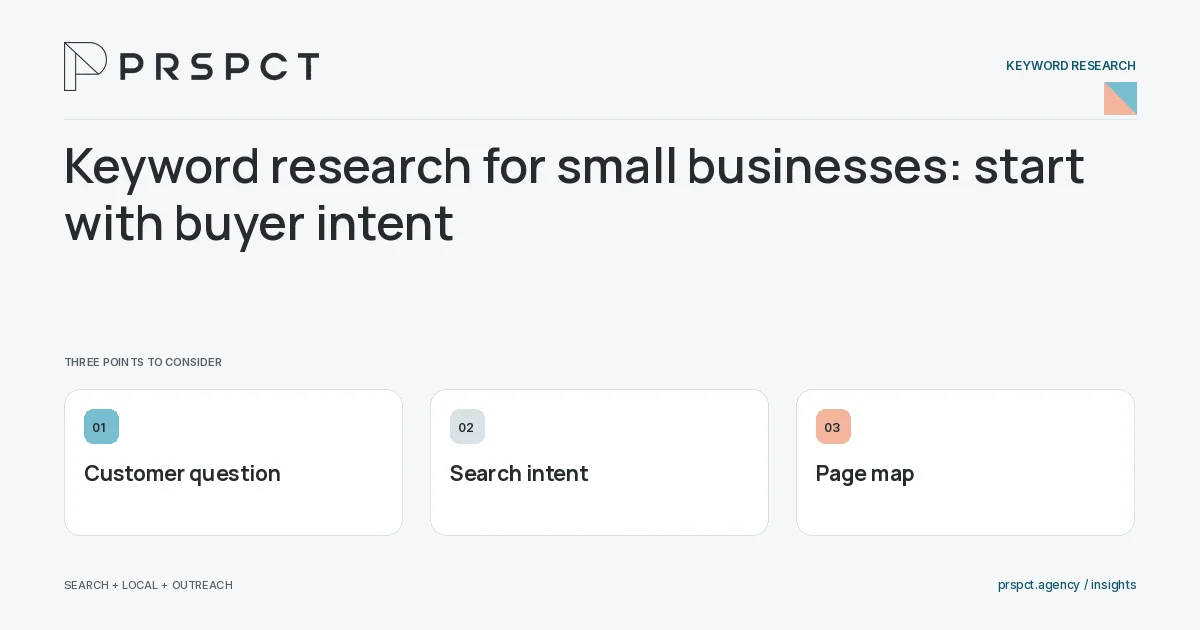
A large keyword list is not yet a content strategy.
List customer decisions
Group real questions about fit, alternatives, preparation, and purchase. Use words customers actually say.
Inspect search intent
Look at current results to see whether the query favors guides, service pages, tools, or local businesses.
Map before writing
Assign each intent to one preferred URL. Keep synonyms together instead of creating separate pages for minor variations.
A practical example
A fictional bookkeeping firm groups “monthly bookkeeping help” with related service searches, while “what records does a bookkeeper need” becomes a supporting preparation guide. Each page has a different job.
A decision checkpoint
Keep demand, competition, and business relevance as separate columns when data is available. A high-volume phrase may still be a poor priority for the offer. When metrics are unavailable, label the choice as an editorial candidate and record what must be validated rather than inventing a numerical score.
A mistake to avoid
Choosing topics only by volume can attract visitors who have no reason to buy.
How to assess the result
Review relevant queries, useful landing-page visits, and inquiry fit. Treat third-party demand estimates as estimates, not a sales forecast.
Put the work in context
Keyword research is most useful when it explains a customer decision. A short phrase can represent several different needs, while a longer query may identify a specific problem that the business can answer well.
Keep one primary intent for each planned page. Record close variants together, inspect the current results, and assign the topic to an existing URL whenever that page already serves the same decision.
A common question
How many keywords should one page target?
Use one coherent intent with natural related phrases. There is no useful universal count that replaces a clear page purpose.
Related reading
- How to find long-tail keywords for a service business
- Keyword mapping template: give every page a clear job
- On-page SEO checklist for a small-business service page
Choose a related question
How to find long-tail keywords for a service business
Long-tail keywords describe specific needs, situations, or constraints. Find them in customer questions, search suggestions, relevant results, and your own search data, then group variations by the decision they represent.
Search intent explained for small-business content planning
Search intent is the task a person wants to complete when searching. Common tasks include learning, comparing, finding a provider, and taking action. Match the page to that task before polishing keywords.
How to choose keywords for a new website with little authority
A new website should prioritize relevant, specific topics it can answer credibly, supported by clear service pages. Use competition evidence and business fit to narrow the plan rather than pursuing only the largest industry terms.
Keyword mapping template: give every page a clear job
A keyword map connects each distinct search intent with a preferred URL, page type, and next step. It prevents separate teams from creating multiple pages for the same question.
Low-volume keywords: when they are worth targeting
A low-volume keyword can be worthwhile when it represents a valuable customer decision, supports a service, or answers a recurring sales question. Assess usefulness and commercial relevance alongside uncertain demand estimates.
How to find content opportunities from competitor websites
A competitor content review finds customer questions your website does not yet answer well. Compare services and intent before treating every competitor keyword as an opportunity.
Branded versus non-branded keywords in SEO reporting
Branded searches contain a business or product name; non-branded searches describe a need without specifying that brand. Separate them to understand existing awareness and broader discovery.
How to turn Search Console queries into blog ideas
Use Search Console queries to identify relevant questions where your pages already receive exposure. Inspect the associated page and intent before deciding whether to improve it or create a separate article.
How to group keywords without creating competing blog posts
Group keywords by the answer the searcher needs, not just shared words. Phrases belong together when one useful page can satisfy them without changing its main task.
Discuss your next priority
PRSPCT helps businesses connect search visibility, local presence, and email outreach. Email josh@prspct.agency to discuss your goals.
References and further reading
The references below support relevant platform definitions and requirements. The planning workflows and labeled examples are PRSPCT editorial guidance.