

Email deliverability
DKIM explained for business owners
DKIM adds a domain-based digital signature to email so receivers can evaluate signed message integrity and identity context. Enable it through each legitimate provider and verify that actual messages carry valid expected signatures.
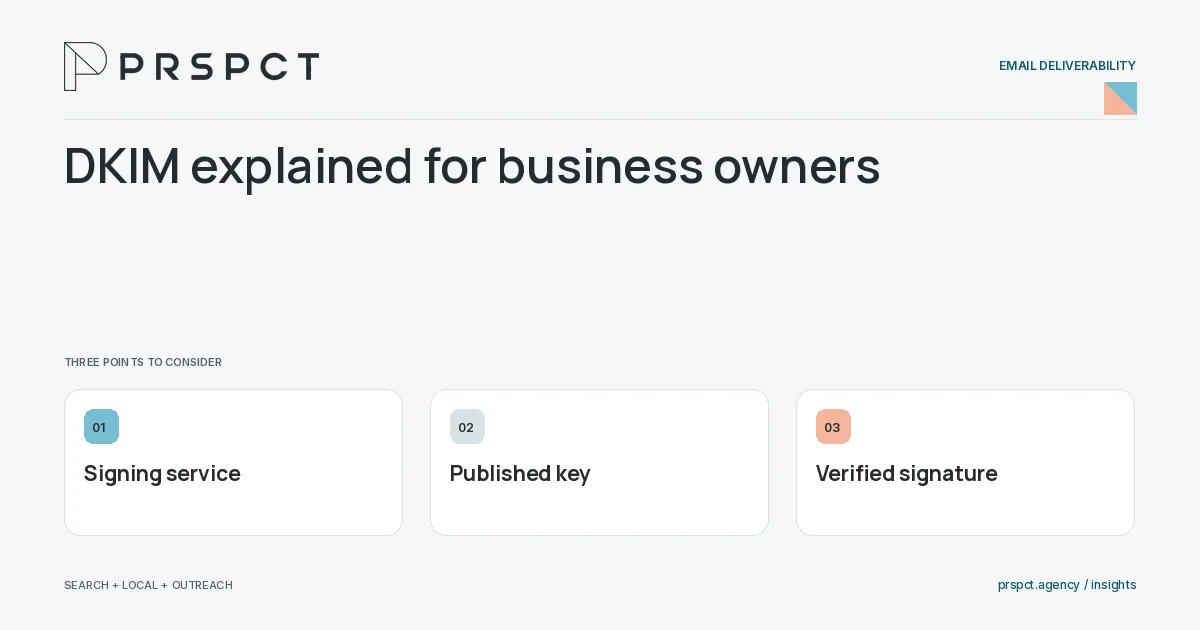
A published key is only part of a working sending setup.
Identify signing services
List the systems that send business and marketing mail.
Follow provider setup
Publish the instructed records and activate signing as required by the service.
Inspect real delivery
Review headers and relevant failures, including whether later processing modifies signed content.
A practical example
A fictional business publishes a provider’s DKIM record but misses the activation step. Header testing reveals that messages are not yet signed as intended.
A decision checkpoint
Verify the signing identity as well as the presence of a signature. A message can carry a valid signature from a service while the intended business-domain setup remains incomplete. Inspect the actual results and alignment context before reporting that the organization’s authentication work is finished.
A mistake to avoid
Assuming DNS publication alone proves every message is signed can hide incomplete setup.
How to assess the result
Check representative messages from each authorized service after changes.
Put the work in context
Deliverability concerns whether appropriate messages reach recipients successfully and are treated as wanted. Authentication, accurate identity, audience expectations, preference handling, and recipient response work together.
Use your provider’s current configuration instructions and test real message headers. Do not copy arbitrary DNS records or treat authentication as permission to send unwanted messages. Investigate evidence before changing infrastructure.
A common question
Does DKIM guarantee inbox placement?
No. It supports authentication, while reputation, relevance, policies, and recipient response still matter.
Related reading
- Email deliverability checklist for small businesses
- DMARC explained: alignment, monitoring, and policy
- One-click unsubscribe versus an email footer link
- B2B prospecting for small businesses: a practical plan
Discuss your next priority
PRSPCT helps businesses connect search visibility, local presence, and email outreach. Email josh@prspct.agency to discuss your goals.
References and further reading
The references below support relevant platform definitions and requirements. The planning workflows and labeled examples are PRSPCT editorial guidance.