

Keyword research
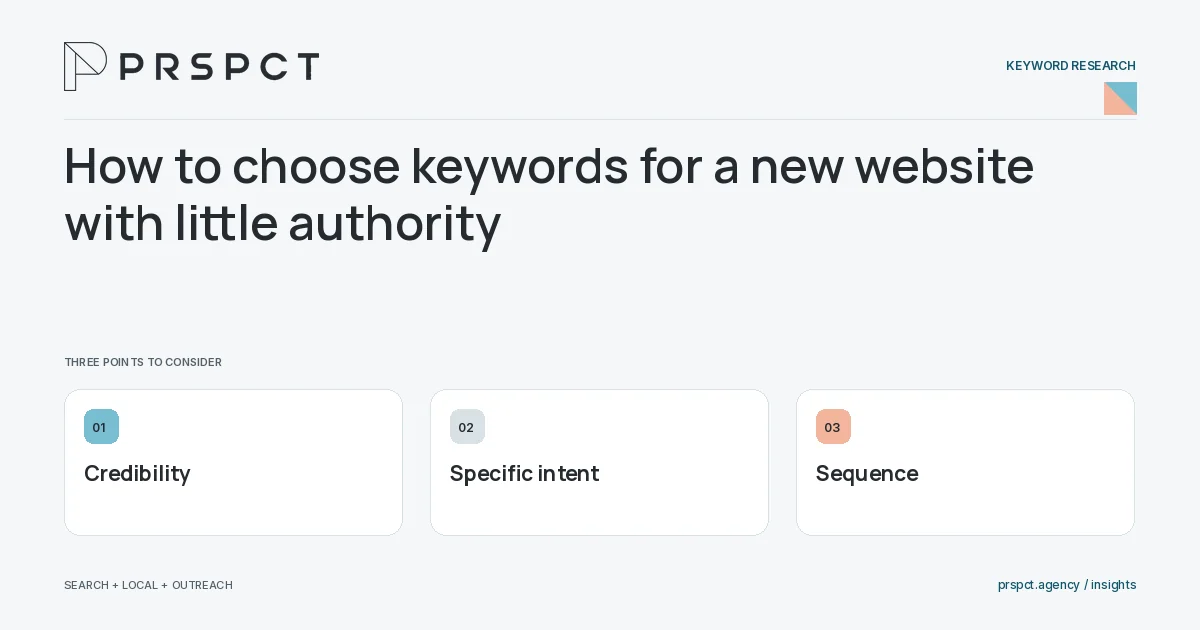
How to choose keywords for a new website with little authority
A new website should prioritize relevant, specific topics it can answer credibly, supported by clear service pages. Use competition evidence and business fit to narrow the plan rather than pursuing only the largest industry terms.
A broad term may be important as a long-term category but unsuitable as the first growth expectation.
Anchor the service pages
Explain the actual services, audience, and boundaries before adding supporting articles.
Find specific decisions
Choose questions with concrete examples your business can provide. Avoid thin definitions of every industry phrase.
Validate and sequence
Inspect results, note evidence gaps, and publish related pages as a coherent group with useful links.
A practical example
A fictional new consultancy builds a focused audit service page and a preparation guide before attempting a broad digital marketing overview. The supporting pages address different buyer needs.
A decision checkpoint
A narrow opportunity still needs credible substance. Before choosing it, list the example, process detail, or decision table you can contribute. If the planned page would only repeat a definition already available everywhere, improve the angle or choose a question your business can answer with greater practical value.
A mistake to avoid
Calling a keyword easy without observing competition or having trustworthy metrics creates false confidence.
How to assess the result
Use early search queries to refine relevance. Track discovery and qualified inquiries without promising a fixed position or date.
Put the work in context
Keyword research is most useful when it explains a customer decision. A short phrase can represent several different needs, while a longer query may identify a specific problem that the business can answer well.
Keep one primary intent for each planned page. Record close variants together, inspect the current results, and assign the topic to an existing URL whenever that page already serves the same decision.
A common question
Can a new website target competitive keywords?
Yes, as long-term coverage. Its early priorities should also include specific questions that fit the business and available evidence.
Related reading
- Keyword research for small businesses: start with buyer intent
- Keyword mapping template: give every page a clear job
- Branded versus non-branded keywords in SEO reporting
- On-page SEO checklist for a small-business service page
Discuss your next priority
PRSPCT helps businesses connect search visibility, local presence, and email outreach. Email josh@prspct.agency to discuss your goals.
References and further reading
The references below support relevant platform definitions and requirements. The planning workflows and labeled examples are PRSPCT editorial guidance.