

Local SEO
Local SEO for a business with multiple real locations
Multi-location SEO requires accurate information and useful pages for each real operation, supported by clear ownership and consistent standards. Preserve legitimate differences in services, hours, and customer experience.
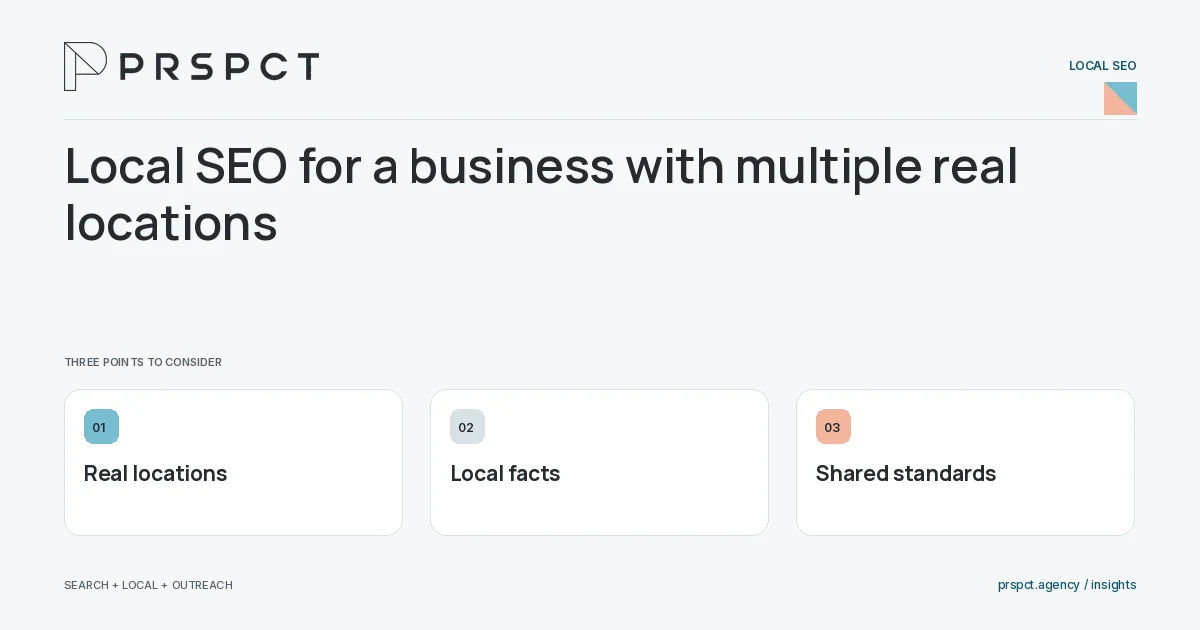
A central template should not erase location-specific facts.
Verify each operation
Record eligibility, contact details, services, and responsibility for maintaining information.
Create useful local pages
Provide genuinely relevant details rather than copying a page and changing the city name.
Coordinate changes
Use a shared update process with local verification before publishing facts.
A practical example
A fictional company has two staffed offices with different appointment options. Each page explains its own process while shared service information links to the central guide.
A decision checkpoint
Establish a central fact record without making one person guess every local detail. Real branch owners should verify hours, services, and practical arrangements. Shared standards then keep formatting and process consistent while preserving operational differences that matter to customers.
A mistake to avoid
Creating pages or profiles for locations the business does not operate misrepresents coverage.
How to assess the result
Review accuracy, location-level inquiries, and routing failures with comparable definitions.
Put the work in context
Local SEO helps a business present accurate, useful information for location-related decisions. Separate the work on website pages, legitimate listings, and customer experience rather than assuming one profile update controls every local result.
Use only real service coverage and eligible locations. Keep a verified business record for names, contact details, hours, and services, and assign an owner to update it when operations change.
A common question
Should every location page be identical?
No. Shared structure can help consistency, but meaningful local details must be accurate and distinct.
Related reading
- Local SEO for small businesses: a practical foundation
- How to prioritize local SEO when you have limited time
- Local citations: how to audit business information
- Google Business Profile optimization checklist for small businesses
Discuss your next priority
PRSPCT helps businesses connect search visibility, local presence, and email outreach. Email josh@prspct.agency to discuss your goals.
References and further reading
The references below support relevant platform definitions and requirements. The planning workflows and labeled examples are PRSPCT editorial guidance.