

Local SEO
Local SEO for small businesses: a practical foundation
Local SEO improves how a business is understood and discovered for location-related searches. Start with accurate business information, eligible profiles, useful service pages, and a working contact path.
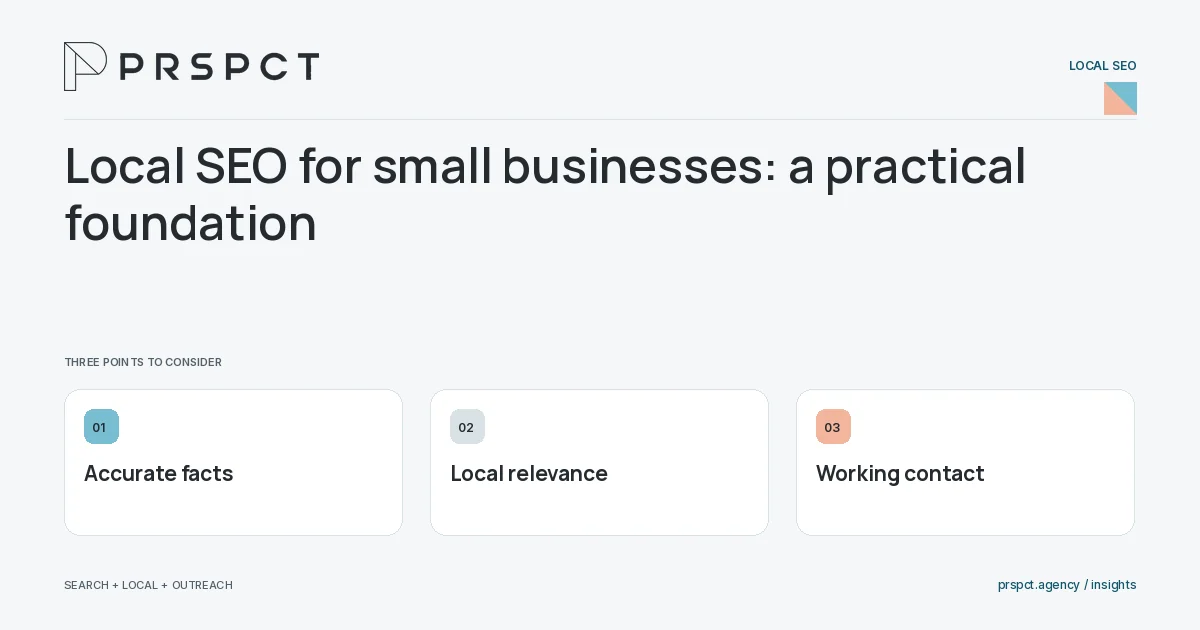
Nearby customers need to understand what you do and whether you serve them.
Verify the business facts
Confirm actual service coverage, contact details, operating hours, and profile eligibility.
Improve local decision pages
Explain relevant services, coverage, and practical next steps with information the business can support.
Maintain the experience
Keep public details current and respond to genuine customer questions and feedback.
A practical example
A fictional repair company corrects its hours, clarifies the towns it actually serves, and links its profile to a useful service page rather than an outdated promotion.
A decision checkpoint
Local customers need an accurate path as well as an accurate listing. Follow the profile link and confirm that the page explains the same service model and coverage. A polished profile can still send prospects to a destination that contradicts the public promise.
A mistake to avoid
Adding place names everywhere does not substitute for real coverage or useful information.
How to assess the result
Review relevant local discovery, valid calls or forms where measurable, and whether inquiries come from workable service areas.
Put the work in context
Local SEO helps a business present accurate, useful information for location-related decisions. Separate the work on website pages, legitimate listings, and customer experience rather than assuming one profile update controls every local result.
Use only real service coverage and eligible locations. Keep a verified business record for names, contact details, hours, and services, and assign an owner to update it when operations change.
A common question
Does local SEO guarantee visibility everywhere nearby?
No. Search context, distance, relevance, competition, and other factors affect local results.
Related reading
- Local SEO versus traditional SEO: what changes?
- Near-me searches: how local businesses should approach them
- Google Business Profile optimization checklist for small businesses
Choose a related question
Local SEO versus traditional SEO: what changes?
Local SEO emphasizes geographic relevance and local business information, while broader SEO may serve audiences without a nearby-provider requirement. The two share website quality, useful content, and technical access.
Local citations: how to audit business information
A local citation audit checks whether relevant listings accurately describe the business. Prioritize legitimate, useful directories and correct material contradictions rather than chasing an arbitrary listing count.
Local SEO checklist for a service-area business
A service-area business should describe its real coverage, maintain eligible business information, and explain how customers request service. Avoid implying a staffed customer-facing office where none exists.
Near-me searches: how local businesses should approach them
For near-me searches, help customers and platforms understand your actual service, location context, and contact options. Use natural local information rather than stuffing the phrase “near me” into headings and business names.
How to measure local SEO without one misleading ranking
Measure local SEO with relevant profile activity, website discovery, and valid inquiries, while documenting location and query context. A single observed map position is not a complete view of local visibility.
Local link building through useful community relationships
Local link building should reflect genuine relationships, useful resources, and relevant public activity. Seek links that help an appropriate audience discover the business, rather than buying artificial placements to manipulate rankings.
Local SEO mistakes that create the wrong inquiries
Local SEO can generate poor-fit inquiries when coverage, services, hours, or customer expectations are unclear. Fix the business information and page message before assuming all unsuitable leads require different traffic.
Local SEO for a business with multiple real locations
Multi-location SEO requires accurate information and useful pages for each real operation, supported by clear ownership and consistent standards. Preserve legitimate differences in services, hours, and customer experience.
How to prioritize local SEO when you have limited time
Prioritize local SEO by fixing inaccurate essential information, clarifying high-value services, and testing the contact path. Add broader content and promotional activity after customers can reliably understand and reach the business.
Discuss your next priority
PRSPCT helps businesses connect search visibility, local presence, and email outreach. Email josh@prspct.agency to discuss your goals.
References and further reading
The references below support relevant platform definitions and requirements. The planning workflows and labeled examples are PRSPCT editorial guidance.