

Local SEO
Local SEO versus traditional SEO: what changes?
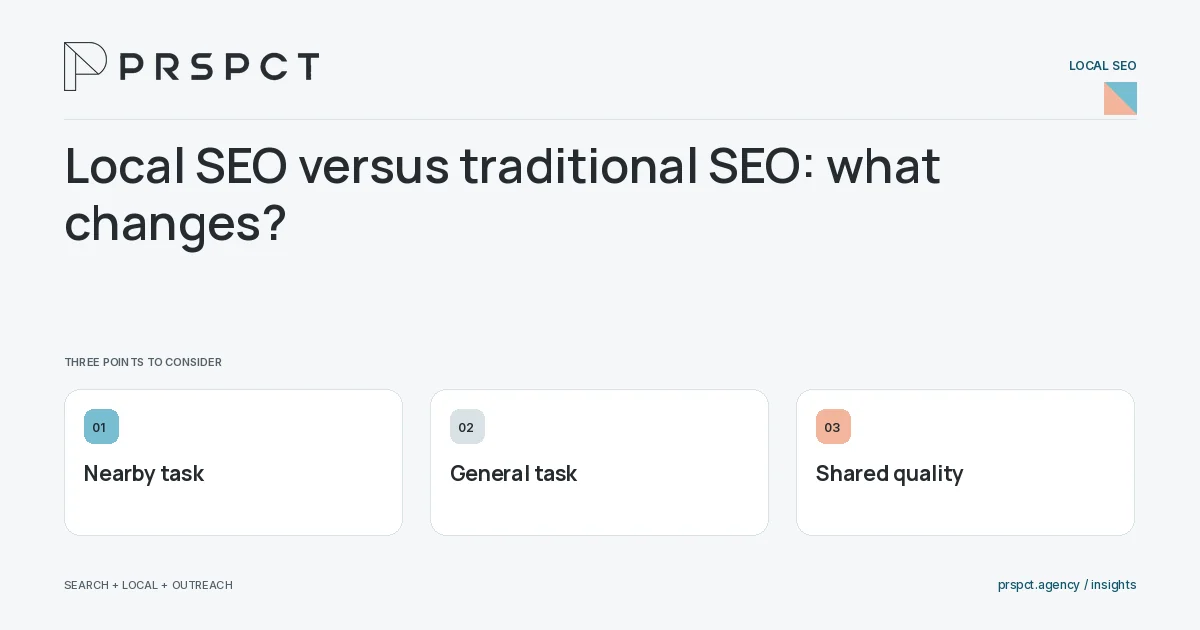
Local SEO emphasizes geographic relevance and local business information, while broader SEO may serve audiences without a nearby-provider requirement. The two share website quality, useful content, and technical access.
A service business may need both approaches for different customer decisions.
Identify local tasks
Separate searches seeking a nearby provider from general educational questions.
Connect the surfaces
Keep website details and eligible profiles consistent. Link to pages relevant to the visitor’s local need.
Measure separately
Distinguish local profile actions, website discovery, and valid inquiries rather than combining them into one unexplained total.
A practical example
A fictional training company uses a city-specific venue page for in-person sessions and a national planning guide for remote buyers. Each resource serves a different situation.
A decision checkpoint
Use the customer’s delivery requirement to choose the emphasis. A remote consultancy may answer national questions without qualifying for the same profile model as a storefront. The website can still explain service availability accurately without inventing a physical presence to fit a local tactic.
A mistake to avoid
Using a local page for a national question can narrow relevance unnecessarily.
How to assess the result
Review where inquiries originate and whether the audience matches actual delivery options.
Put the work in context
Local SEO helps a business present accurate, useful information for location-related decisions. Separate the work on website pages, legitimate listings, and customer experience rather than assuming one profile update controls every local result.
Use only real service coverage and eligible locations. Keep a verified business record for names, contact details, hours, and services, and assign an owner to update it when operations change.
A common question
Does every business need a Google Business Profile?
Eligibility depends on the business model. Do not assume an online-only business qualifies.
Related reading
- Local SEO for small businesses: a practical foundation
- Local citations: how to audit business information
- How to measure local SEO without one misleading ranking
- Google Business Profile optimization checklist for small businesses
Discuss your next priority
PRSPCT helps businesses connect search visibility, local presence, and email outreach. Email josh@prspct.agency to discuss your goals.
References and further reading
The references below support relevant platform definitions and requirements. The planning workflows and labeled examples are PRSPCT editorial guidance.