

Reviews and reputation
Online reputation management for small businesses
Online reputation management means maintaining accurate public information, responding to genuine feedback, and improving recurring customer problems. It should build a trustworthy record of the business rather than hide criticism or fabricate praise.
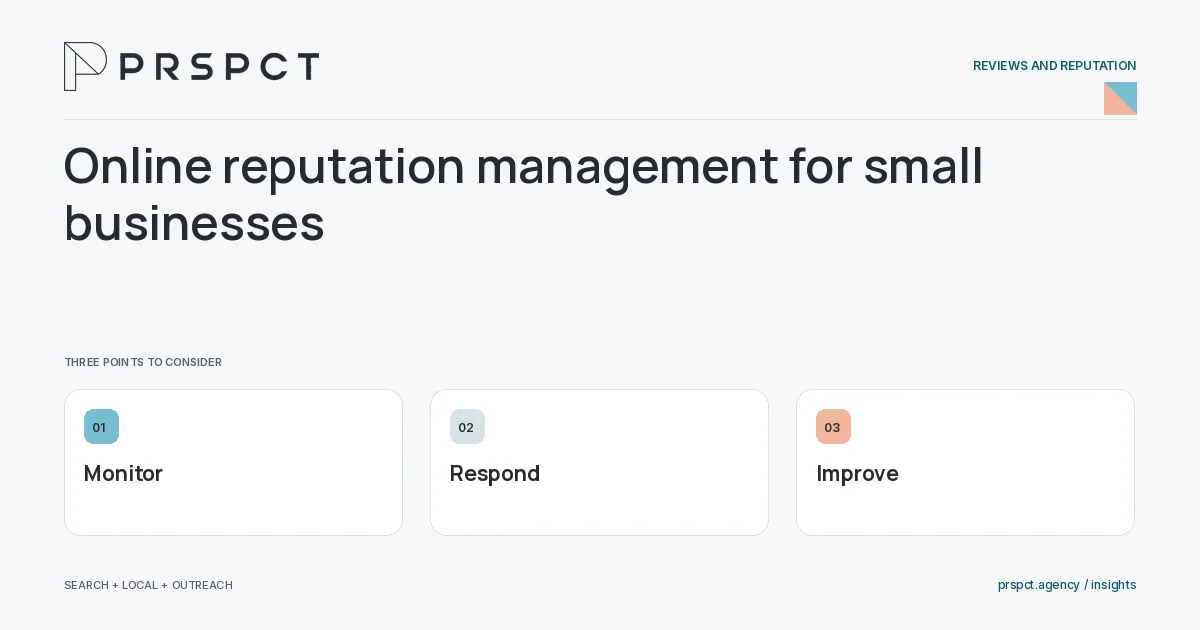
A response process works best when operations can act on the feedback.
Monitor relevant surfaces
Choose the platforms customers actually use and assign a responsible reviewer.
Respond proportionately
Acknowledge specific concerns without exposing private details or arguing publicly.
Learn from patterns
Group recurring issues and assign operational fixes. Keep the public promise aligned with reality.
A practical example
A fictional service company notices repeated confusion about arrival windows. It improves booking instructions and response templates rather than merely asking for more positive reviews.
A decision checkpoint
Reputation work should feed back into the service process. If the same issue appears repeatedly, assign a practical fix and verify it happened. A well-written public reply is only one part of addressing the experience that produced the review.
A mistake to avoid
Treating reputation as a review-count contest ignores the customer experience behind the feedback.
How to assess the result
Track response completion, recurring themes, and resolution work alongside public rating context.
Put the work in context
Customer feedback is evidence of individual experiences, not material to manufacture. Build a consistent process for genuine requests, thoughtful responses, and operational learning while following each platform’s rules.
Assign a response owner and an escalation path. Protect personal details in public replies, preserve truthful records, and separate service recovery from any request for a public review.
A common question
Can reputation management remove every negative review?
No. Legitimate criticism is not automatically removable, and platforms control their own review decisions.
Related reading
- How to ask customers for Google reviews appropriately
- How to respond to positive reviews without sounding repetitive
- Service-area pages: when they deserve separate URLs
Choose a related question
How to ask customers for Google reviews appropriately
Ask customers for an honest review through a neutral, convenient process. Avoid rewards, pressure, or selective invitations designed to screen out negative experiences, and follow Google’s review policies.
Review request email template for a service business
A review request email should identify the completed interaction, invite an honest account, and make the review destination easy to find. Keep it short, optional, and free of rewards or suggested ratings.
How to respond to a negative review professionally
Respond to a negative review by acknowledging the concern, stating a proportionate next step, and moving private details to an appropriate support channel. Keep the reply factual and avoid arguing about confidential events in public.
How to respond to positive reviews without sounding repetitive
A positive-review response should thank the customer and acknowledge a specific non-sensitive part of the feedback. Keep it natural rather than turning every reply into a keyword-heavy sales message.
Review gating explained: build a fair feedback process
Review gating is a process that steers selected satisfied customers toward public reviews while diverting dissatisfied customers away. Use a fair request process that does not manipulate who gets invited based on predicted sentiment.
What to do about a suspicious or fake business review
When a review appears suspicious, preserve evidence, compare it with the platform’s policies, and use the legitimate reporting process. Do not assume that an unfamiliar name or negative opinion proves the review is fake.
How to use customer testimonials on a service website
Use testimonials only when they reflect real experiences and you have an appropriate basis to publish them. Preserve meaning, disclose relevant relationships where required, and avoid implying results that the evidence cannot support.
Turn customer reviews into service improvements
Review analysis groups genuine feedback into themes the business can act on. Separate frequency, severity, and context so that one loud complaint does not automatically become the whole strategy.
Review management handoff checklist for a small team
A review-management handoff defines who monitors, drafts, approves, responds, and escalates feedback. It also sets privacy boundaries and a process for recording operational lessons.
Discuss your next priority
PRSPCT helps businesses connect search visibility, local presence, and email outreach. Email josh@prspct.agency to discuss your goals.
References and further reading
The references below support relevant platform definitions and requirements. The planning workflows and labeled examples are PRSPCT editorial guidance.