

Service and location pages
Service-area pages: when they deserve separate URLs
A service-area page deserves a separate URL when it provides meaningful information for customers in that area, such as real coverage, logistics, service differences, or relevant evidence. A city-name swap alone is not enough.
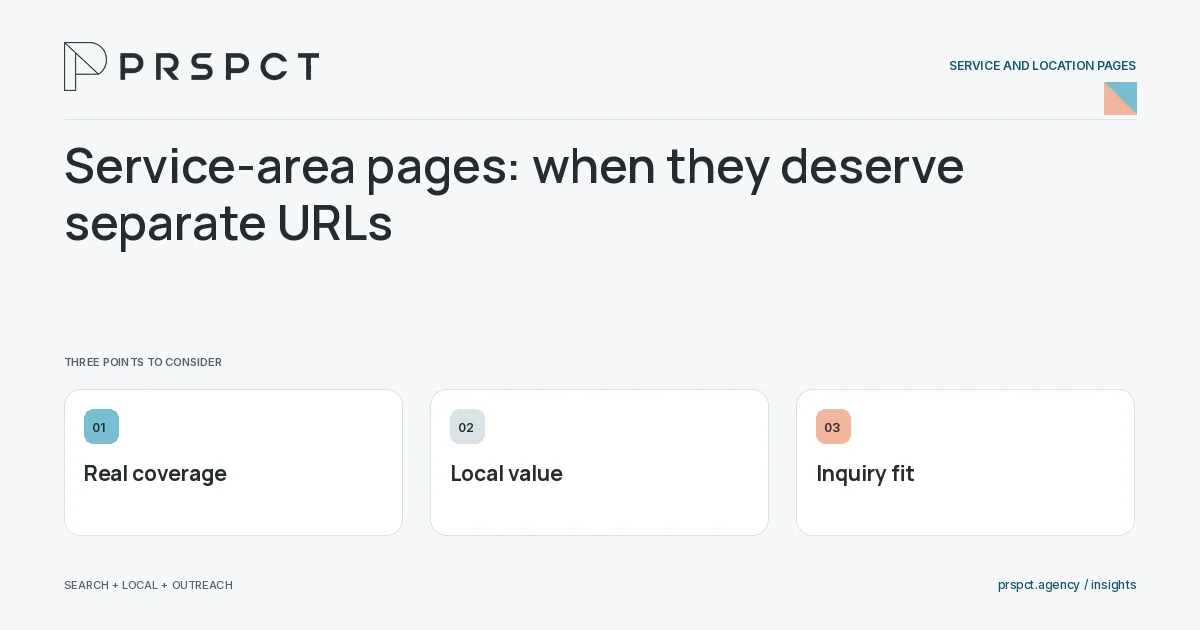
The page needs a reason for a local customer to read it.
Confirm real coverage
Verify where the team actually works and any practical travel or scheduling limits.
Identify unique value
Explain local delivery context or service details that materially affect the decision.
Connect the inquiry
Provide an appropriate contact path and collect location detail needed to confirm fit.
A practical example
A fictional maintenance provider creates one useful regional page explaining its travel process rather than ten copied town pages with no different information.
A decision checkpoint
A useful coverage page should explain what happens at the boundary. If travel or service availability depends on the job, say that accurately and provide a way to confirm fit. Do not turn uncertain coverage into a promise merely to include another location term.
A mistake to avoid
Inventing local detail to make pages look unique creates false content.
How to assess the result
Review area-specific inquiries and whether the page reduces coverage confusion.
Put the work in context
A service or location page should help a visitor evaluate a real offering in a real delivery context. Shared structure can make the site consistent, but city-name substitutions alone do not create useful distinct pages.
Before creating a URL, confirm the service, audience, coverage, evidence, and next step. Link overlapping resources appropriately and avoid implying a physical office where the business only travels to customers.
A common question
Should every nearby town get a page?
No. Separate pages need distinct value and real service relevance.
Related reading
- Location page checklist for a real business branch
- Doorway pages explained for service businesses
- Lead generation for small businesses: build the full path
Choose a related question
Location page checklist for a real business branch
A real branch page should explain accurate location details, relevant services, visit or appointment arrangements, and a working contact route. Include useful local information that the business can verify.
How to write a service page that qualifies inquiries
A strong service page explains what the business does, who it fits, how the process works, important boundaries, and the next step. It helps appropriate prospects act while reducing avoidable mismatches.
City pages versus regional pages: how to choose
Choose city or regional pages according to real service differences and useful information, not the number of place names you want to target. One strong coverage page can be more useful than many near-identical local pages.
Doorway pages explained for service businesses
Doorway pages are pages created to capture similar searches and funnel visitors toward the same destination without distinct useful value. Avoid large sets of location or keyword variants that repeat substantially the same answer.
Service page FAQs: questions that help customers decide
Useful service FAQs address unresolved questions about fit, preparation, process, and boundaries. Choose actual buyer concerns and avoid repeating promotional claims in question form.
How to add proof to a service page without invented claims
Service-page proof should use verifiable facts, permissioned examples, accurate process descriptions, and genuine feedback. If client results are unavailable, explain the work clearly instead of inventing logos, numbers, or testimonials.
How to organize a service website with several offerings
Organize multiple services around meaningful customer decisions, with a clear service hub and focused pages for genuinely different offers. Keep navigation understandable and link related educational resources where useful.
Contact page content that improves lead quality
A contact page should explain what the inquiry is for, what information is useful, and how the request reaches the business. Keep the action clear and avoid collecting detail the team will not use.
Service page refresh checklist after your offer changes
When an offer changes, update its page, navigation, related guides, profile details, and inquiry routing together. The public explanation should match what the team can currently deliver.
Discuss your next priority
PRSPCT helps businesses connect search visibility, local presence, and email outreach. Email josh@prspct.agency to discuss your goals.
References and further reading
The references below support relevant platform definitions and requirements. The planning workflows and labeled examples are PRSPCT editorial guidance.