

Technical SEO
Robots.txt versus noindex: which control does what?
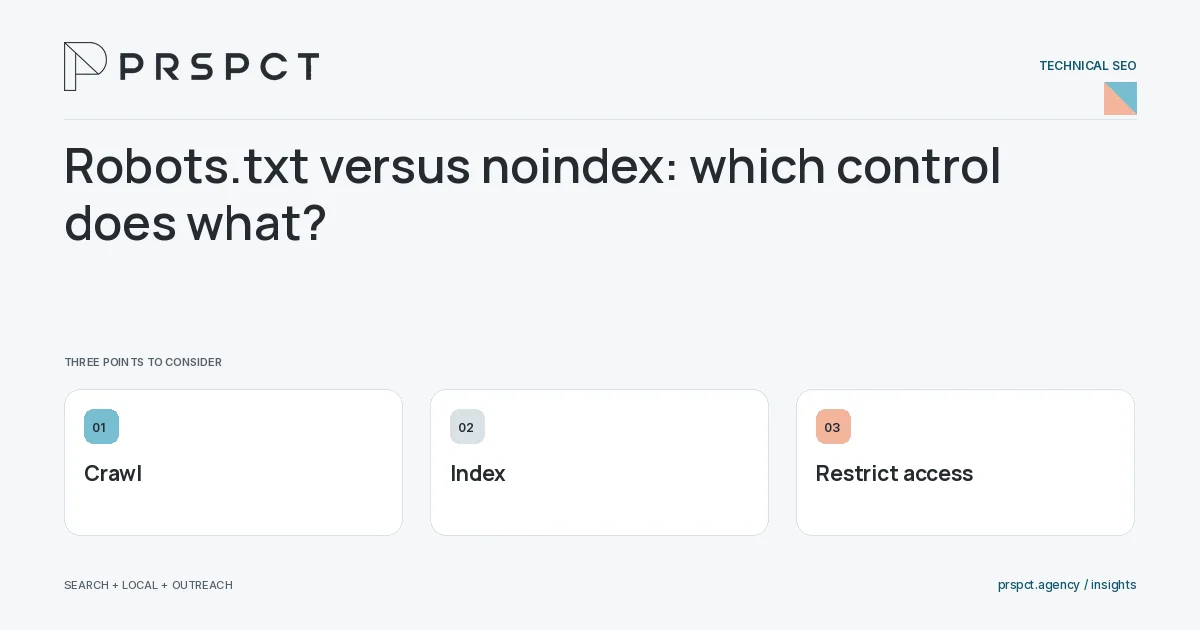
Robots.txt controls crawler access to paths, while a noindex directive asks supported search engines not to index an accessible page. A crawler generally needs access to read a page-level noindex directive.
Neither control is a substitute for authentication on private information.
Name the objective
Decide whether you want to reduce crawling, prevent indexing, or restrict access. These are separate requirements.
Choose the appropriate control
Use crawl rules for crawl management, indexing directives for indexing, and access controls for confidential content.
Test visibility
Inspect the live response and crawler access. Avoid blocking a URL whose noindex change needs to be read.
A practical example
A fictional thank-you page needs to stay out of search. The team uses an accessible noindex directive rather than assuming a robots.txt disallow will reliably remove it.
A decision checkpoint
When removing a page from search, think about how the search engine can observe the change. Blocking access at the same time can prevent it from reading an updated directive. Use the appropriate current removal and access guidance for the situation, and do not treat an indexing control as security.
A mistake to avoid
Using robots.txt as a privacy barrier can leave sensitive URLs publicly reachable.
How to assess the result
Review representative URLs with inspection tools and confirm private areas require real authorization.
Put the work in context
Technical SEO makes useful content accessible and consistently identifiable. Diagnose the specific failure before applying a sitewide change: crawl access, indexing signals, rendering, redirects, and page experience solve different problems.
Test representative URLs from each page template after changes. Keep staging and production settings separate, and confirm that the published HTML, status code, canonical URL, and sitemap describe the same intended destination.
A common question
Can a blocked URL still appear in search?
A URL may be known from other signals even when crawling is blocked. Crawl control and indexing control differ.
Related reading
- Technical SEO checklist for a small website
- XML sitemaps for a small-business website
- JavaScript SEO checks for a new business website
- Content marketing for small businesses: build a useful library
Discuss your next priority
PRSPCT helps businesses connect search visibility, local presence, and email outreach. Email josh@prspct.agency to discuss your goals.
References and further reading
The references below support relevant platform definitions and requirements. The planning workflows and labeled examples are PRSPCT editorial guidance.