

SEO foundations
SEO for a one-page website: limits and priorities
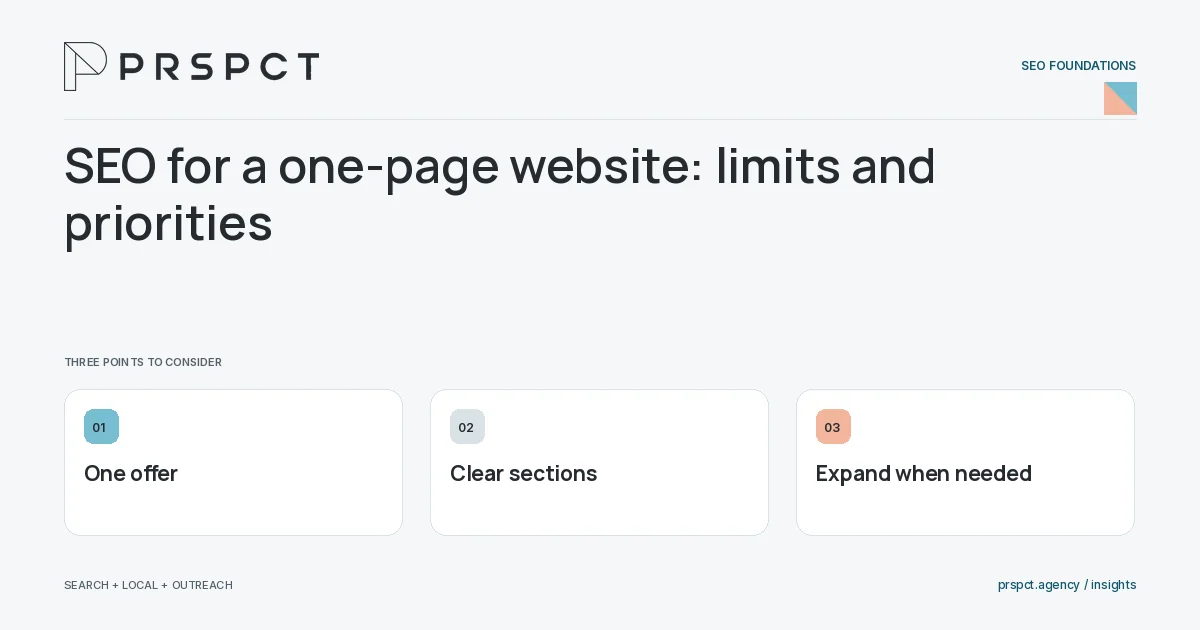
A one-page website can explain a focused business, but it has limited room to serve distinct search intents. Prioritize one core offer and a clear contact path; add separate pages when different services or questions need substantial answers.
Trying to fit every keyword into one long page can blur its purpose and make navigation harder.
Choose the primary intent
Identify the main service and audience. Use the page title and main heading to communicate that focus.
Organize decision sections
Explain the service, fit, process, evidence, and contact action with clear headings and accessible navigation.
Define expansion triggers
Create a separate page when a topic needs its own explanation, conversion path, or customer decision. Avoid splitting tiny variations into thin pages.
A practical example
A fictional solo editor starts with one page about business copy editing. As it adds a distinct manuscript service, that offer gets a dedicated page rather than being squeezed into the original introduction.
A decision checkpoint
Use a separate URL when the visitor needs a different decision, not merely a different heading. If a new service has its own fit criteria and process, a page can help. If the distinction is a minor variation of the same offer, a clear section may be sufficient.
A mistake to avoid
Using headings as keyword storage weakens readability without creating genuinely useful topic coverage.
How to assess the result
Review which queries appear and what visitors ask before contacting you. Those questions can reveal when the single-page structure becomes limiting.
Put the work in context
Search engine optimization connects useful website information with people looking for it. For a service business, visibility is valuable when the page also makes the service, audience, and next step clear.
Keep an implementation log with the affected URL, reason for the change, and release date. Use that record when comparing search activity and sales inquiries; several changes made together are difficult to attribute individually.
A common question
Can anchor links replace separate service pages?
Anchor links help navigation within a page. They do not create independent pages with their own titles, URLs, and focused content.
Related reading
- SEO for small businesses: what to fix first
- How to use customer questions to improve SEO
- Keyword research for small businesses: start with buyer intent
Discuss your next priority
PRSPCT helps businesses connect search visibility, local presence, and email outreach. Email josh@prspct.agency to discuss your goals.
References and further reading
The references below support relevant platform definitions and requirements. The planning workflows and labeled examples are PRSPCT editorial guidance.