

SEO foundations
SEO terminology for business owners: a plain-language guide
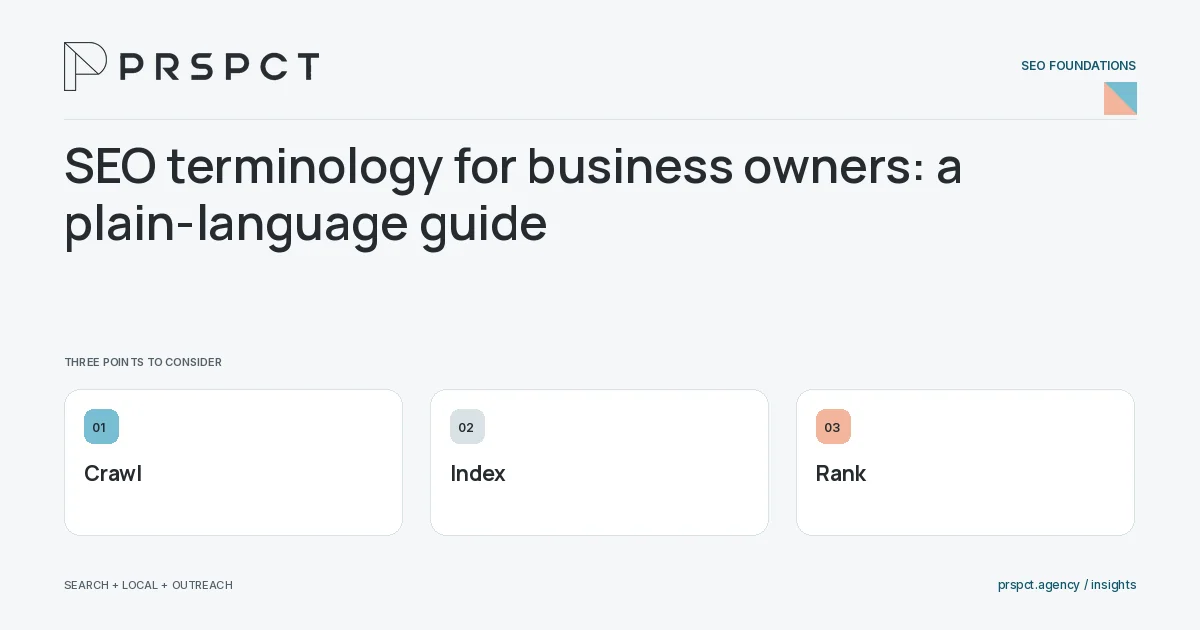
SEO terms describe different stages of discovery and evaluation. Crawling means fetching a page, indexing means considering it for storage and retrieval, and ranking means ordering results for a particular search. These stages should not be treated as interchangeable.
Clear terminology helps owners ask better questions and spot reports that confuse completed work with business results.
Separate technical states
Ask whether a page loads, can be crawled, and is indexed. Each question needs different evidence.
Separate visibility from outcomes
Impressions and positions describe search exposure. Clicks, valid inquiries, and customers describe later stages with different measurement limits.
Translate terms into decisions
For every reported issue, ask which page is affected, why customers care, and what action the team recommends.
A practical example
A fictional owner hears that a page is “optimized.” She asks whether its technical access, customer answer, internal links, and inquiry path have been checked. The discussion becomes more concrete than a single label.
A decision checkpoint
Ask for evidence at the correct level. “Crawled” needs a different explanation from “indexed,” and neither proves a page is attracting suitable customers. Translating each term into an observable state prevents technical progress from being confused with the later business outcome the owner ultimately needs.
A mistake to avoid
Using a technical score as a substitute for explaining customer impact can make a report look more certain than it is.
How to assess the result
Keep a short shared glossary beside reports. Use stable definitions so different team members interpret changes consistently.
Put the work in context
Search engine optimization connects useful website information with people looking for it. For a service business, visibility is valuable when the page also makes the service, audience, and next step clear.
Keep an implementation log with the affected URL, reason for the change, and release date. Use that record when comparing search activity and sales inquiries; several changes made together are difficult to attribute individually.
A common question
Is indexing the same as ranking?
No. An indexed page may be eligible to appear, but its position and exposure depend on the search and many other factors.
Related reading
- SEO for small businesses: what to fix first
- SEO checklist for a new website launch
- Keyword research for small businesses: start with buyer intent
Discuss your next priority
PRSPCT helps businesses connect search visibility, local presence, and email outreach. Email josh@prspct.agency to discuss your goals.
References and further reading
The references below support relevant platform definitions and requirements. The planning workflows and labeled examples are PRSPCT editorial guidance.