

Service and location pages
How to organize a service website with several offerings
Organize multiple services around meaningful customer decisions, with a clear service hub and focused pages for genuinely different offers. Keep navigation understandable and link related educational resources where useful.
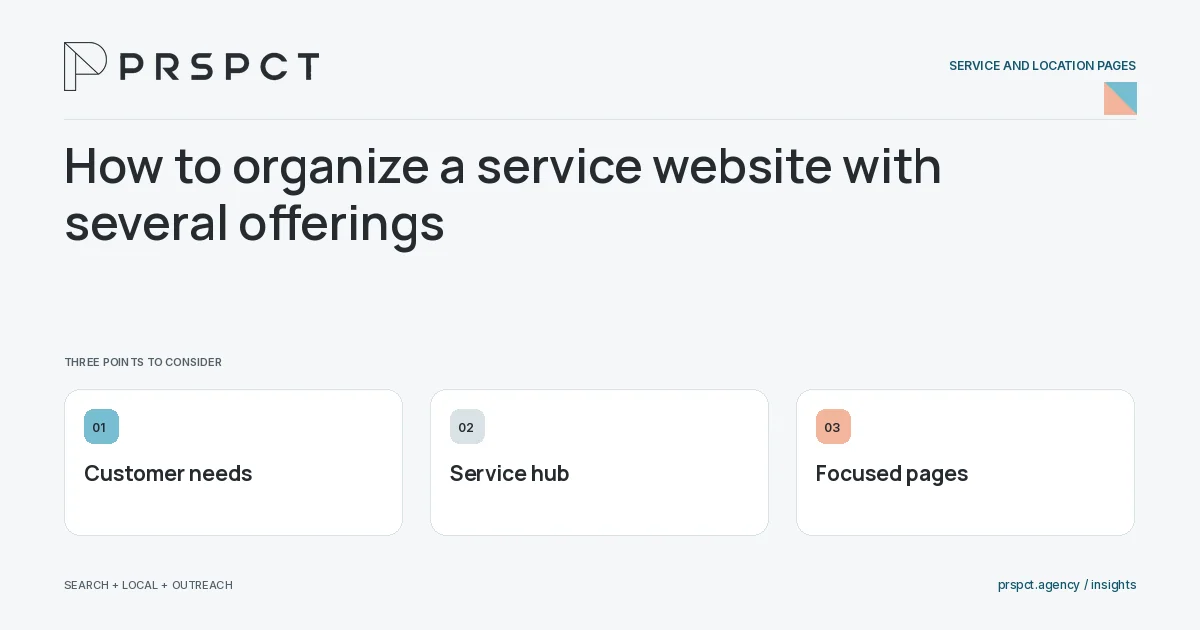
The structure should help visitors choose, not mirror every internal task.
Group by customer need
Use labels customers recognize and avoid splitting tiny deliverables into separate sales pages.
Give each offer a purpose
Explain fit, process, boundaries, and the appropriate next action on its page.
Connect related resources
Link supporting guides and related services without duplicating their full explanations.
A practical example
A fictional firm groups search visibility, local presence, and email work clearly, then explains the distinct scope within each family rather than presenting a long flat menu.
A decision checkpoint
Navigation labels should reflect customer understanding. An internal department name may be meaningful to staff but opaque to a new prospect. Use clear service language in the menu and explain the relationship between offerings on the hub rather than expecting visitors to decode the organization chart.
A mistake to avoid
Creating a separate page for every keyword variation can make the offering harder to understand.
How to assess the result
Review navigation paths and questions that suggest visitors cannot identify the right service.
Put the work in context
A service or location page should help a visitor evaluate a real offering in a real delivery context. Shared structure can make the site consistent, but city-name substitutions alone do not create useful distinct pages.
Before creating a URL, confirm the service, audience, coverage, evidence, and next step. Link overlapping resources appropriately and avoid implying a physical office where the business only travels to customers.
A common question
Should every service page use identical copy?
Use consistent structure, but each offer needs its own accurate explanation and decision value.
Related reading
- Service-area pages: when they deserve separate URLs
- Contact page content that improves lead quality
- Location page checklist for a real business branch
- Lead generation for small businesses: build the full path
Discuss your next priority
PRSPCT helps businesses connect search visibility, local presence, and email outreach. Email josh@prspct.agency to discuss your goals.
References and further reading
The references below support relevant platform definitions and requirements. The planning workflows and labeled examples are PRSPCT editorial guidance.