

SEO foundations
Why your website gets traffic but no leads
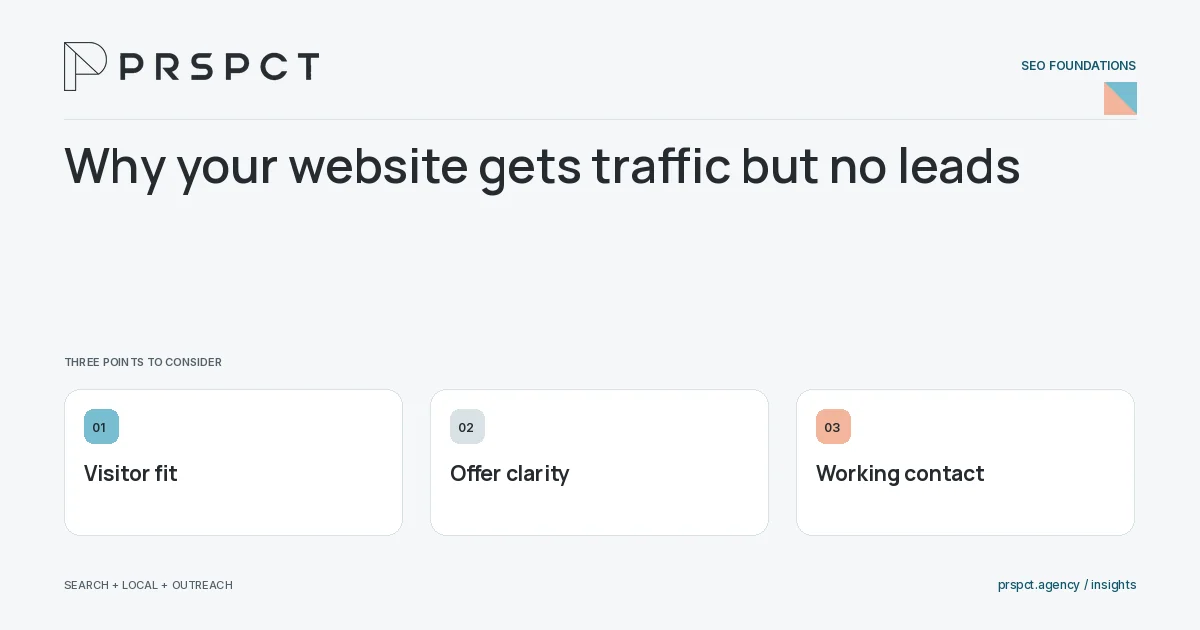
Website traffic without leads can result from irrelevant visitors, an unclear offer, weak evidence, excessive friction, or a broken contact path. Diagnose the visitor-to-inquiry journey before assuming the business simply needs more traffic.
A popular informational article may answer a question for people who will never need the service. That is a different issue from a quote form that fails.
Inspect audience fit
Review the pages and queries bringing visitors. Separate likely buyers from students, job seekers, suppliers, and unrelated searches.
Check the decision information
Look for a clear service description, fit boundaries, process, and credible evidence. Visitors should understand what contacting the business will accomplish.
Test the actual action
Complete forms on mobile, check inbox receipt, and inspect booking links. Compare recorded events with backend submissions.
A practical example
A fictional IT firm gets traffic to a free troubleshooting guide but few managed-service inquiries. It adds a relevant service explanation and keeps the self-help answer intact. It also discovers a mobile validation error on its contact form.
A decision checkpoint
Review actual inquiries as well as aggregate behavior. If visitors repeatedly ask what the service includes, the page may be missing decision information. If the requests are all unrelated, the larger problem may be intent. Those cases deserve different changes even when both appear as a low conversion rate.
A mistake to avoid
Adding more buttons cannot compensate for an audience that does not need the offer.
How to assess the result
Track valid inquiries per relevant landing-page session and review inquiry fit. Avoid counting button clicks as completed leads.
Put the work in context
Search engine optimization connects useful website information with people looking for it. For a service business, visibility is valuable when the page also makes the service, audience, and next step clear.
Keep an implementation log with the affected URL, reason for the change, and release date. Use that record when comparing search activity and sales inquiries; several changes made together are difficult to attribute individually.
A common question
Is a low conversion rate always a design problem?
No. Audience intent, service fit, pricing expectations, technical failures, and follow-up can all affect inquiries.
Related reading
- SEO for small businesses: what to fix first
- How to choose an SEO agency without ranking promises
- What an SEO maintenance plan should include
- Keyword research for small businesses: start with buyer intent
Discuss your next priority
PRSPCT helps businesses connect search visibility, local presence, and email outreach. Email josh@prspct.agency to discuss your goals.
References and further reading
The references below support relevant platform definitions and requirements. The planning workflows and labeled examples are PRSPCT editorial guidance.