

Content strategy
Blog content calendar for a small service business
A useful blog calendar records the customer question, preferred URL, owner, evidence, dependencies, and review date. Schedule content according to business relevance and readiness rather than filling dates with generic topics.
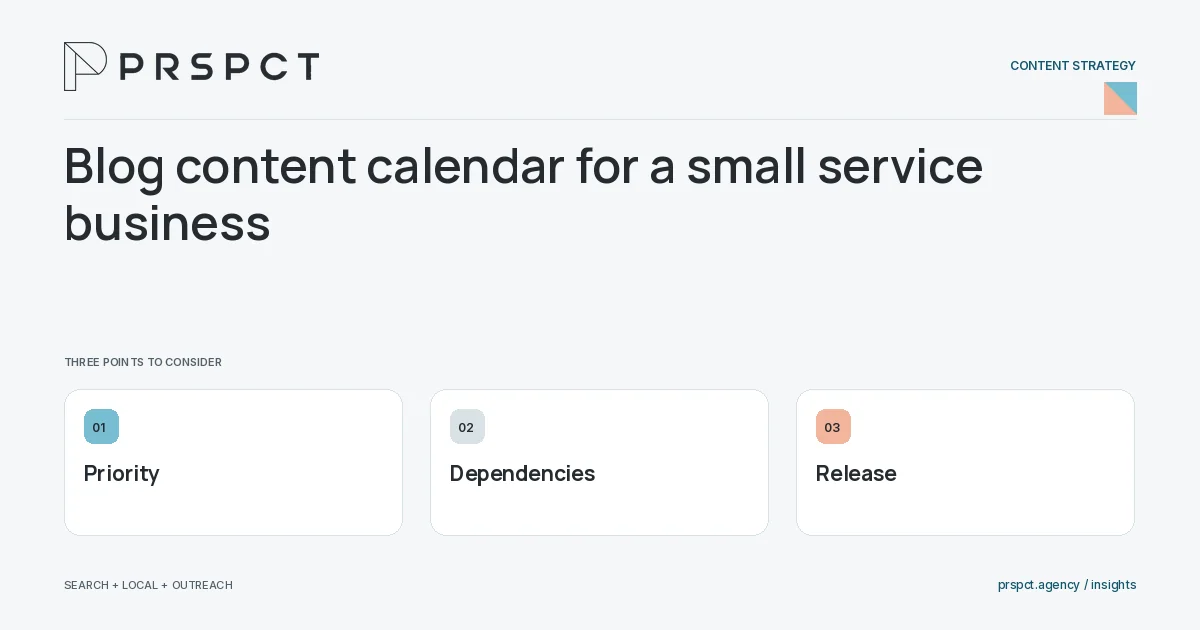
A calendar should make work easier to complete and maintain.
Prioritize decisions
Select questions connected to actual services and recurring buyer needs. Mark broader terms as longer-term coverage.
Check dependencies
Confirm that service pages, examples, graphics, and approval inputs are ready before setting release dates.
Reserve maintenance time
Schedule updates and link checks alongside new articles. Leave capacity for questions discovered after launch.
A practical example
A fictional studio schedules its preparation guide after the related service page is complete. A planned broad industry post waits because it lacks a useful original example.
A decision checkpoint
Use a readiness column alongside the planned order. A topic with approved facts and a strong example may be ready before a nominally higher-priority article waiting on evidence. This lets production continue without filling gaps with assumptions or repeatedly missing artificial calendar dates.
A mistake to avoid
A full calendar can conceal unfinished research and create pressure to publish weak material.
How to assess the result
Track completed useful resources and their role in discovery and inquiries, not only adherence to a posting schedule.
Put the work in context
A content strategy should explain why each resource belongs on the website. Useful coverage supports real customer decisions; a larger publishing calendar is not automatically a stronger one.
Maintain a topic map with the preferred URL, intended reader task, evidence, and next action. Review overlap before drafting and revisit the map when customer questions or the business offer change.
A common question
Should a calendar include publication dates immediately?
Use dates when owners and dependencies are clear. An ordered backlog is often better than invented commitments.
Related reading
- Content marketing for small businesses: build a useful library
- How to refresh outdated blog content without changing its purpose
- Case study versus illustrative example: honest marketing content
- SEO reporting for small businesses: what to measure
Discuss your next priority
PRSPCT helps businesses connect search visibility, local presence, and email outreach. Email josh@prspct.agency to discuss your goals.
References and further reading
The references below support relevant platform definitions and requirements. The planning workflows and labeled examples are PRSPCT editorial guidance.