

Service and location pages
City pages versus regional pages: how to choose
Choose city or regional pages according to real service differences and useful information, not the number of place names you want to target. One strong coverage page can be more useful than many near-identical local pages.
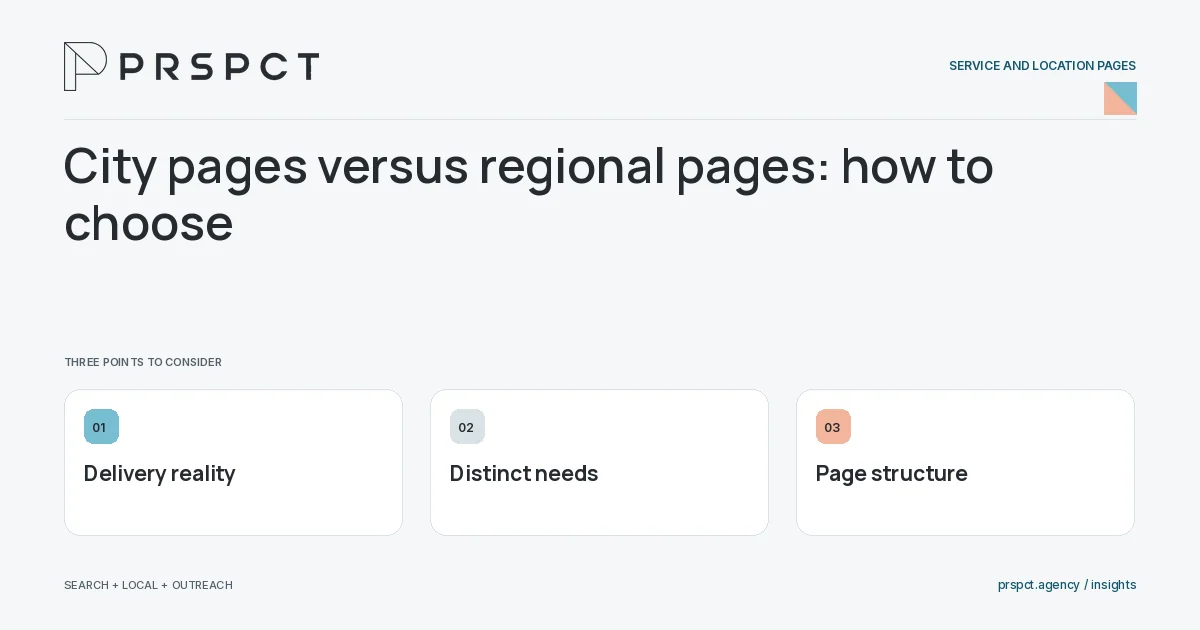
Page structure should reflect how the business delivers service.
Map delivery reality
Document travel limits, branches, staffing, and service variation across the footprint.
Compare content needs
Ask whether each city needs a materially different answer or whether a shared regional explanation serves customers better.
Use clear navigation
Make coverage understandable without forcing visitors through a maze of location lists.
A practical example
A fictional mobile provider serves neighboring towns through one scheduling process. It uses a regional page and clear coverage details instead of creating thin city copies.
A decision checkpoint
A regional page can still provide a specific answer. It can explain scheduling, coverage confirmation, or travel considerations that apply across the area. If there is no meaningful city-specific difference, that shared explanation may be more useful than maintaining numerous nearly identical pages.
A mistake to avoid
A larger location-page count is not proof of stronger local relevance.
How to assess the result
Review customer questions and suitable inquiry locations. Split pages only when distinct needs justify it.
Put the work in context
A service or location page should help a visitor evaluate a real offering in a real delivery context. Shared structure can make the site consistent, but city-name substitutions alone do not create useful distinct pages.
Before creating a URL, confirm the service, audience, coverage, evidence, and next step. Link overlapping resources appropriately and avoid implying a physical office where the business only travels to customers.
A common question
Can a regional page mention several towns?
Yes, when the coverage is real and the information remains useful and readable.
Related reading
- Service-area pages: when they deserve separate URLs
- Doorway pages explained for service businesses
- How to organize a service website with several offerings
- Lead generation for small businesses: build the full path
Discuss your next priority
PRSPCT helps businesses connect search visibility, local presence, and email outreach. Email josh@prspct.agency to discuss your goals.
References and further reading
The references below support relevant platform definitions and requirements. The planning workflows and labeled examples are PRSPCT editorial guidance.