

Email segmentation
Email segmentation for small businesses: start with useful groups
Email segmentation divides an eligible audience into groups receiving more relevant messages. Begin with a few meaningful differences such as stated interest, relationship stage, or service context rather than dozens of weakly supported categories.
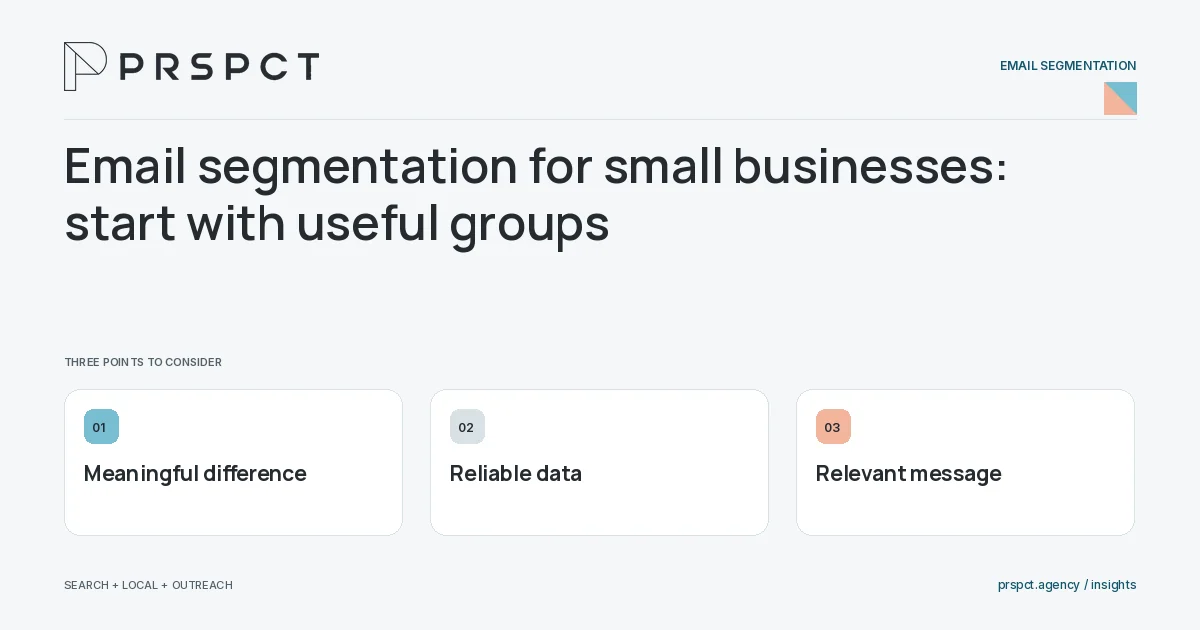
A segment should change what you say or why you send.
Choose the decision
Identify which audience difference makes a message more useful.
Use reliable information
Prefer stated preferences and legitimate records over unsupported assumptions.
Test membership
Review included and excluded examples before sending.
A practical example
A fictional subscriber list separates planning topics people selected at signup. Each group receives relevant resources without assuming that interest proves immediate purchase intent.
A decision checkpoint
Begin with the message difference, then build the segment. If the same email would be sent unchanged to every group, the extra segmentation may add maintenance without relevance. Use the smallest reliable distinction that improves the subscriber’s understanding or next action.
A mistake to avoid
Adding segments nobody can maintain creates stale or contradictory audiences.
How to assess the result
Review relevance, useful actions, opt-outs, and rule accuracy.
Put the work in context
Segmentation makes a message relevant to a defined audience. Start with information people provide and legitimate business context; avoid sensitive assumptions or treating uncertain activity as a complete picture of intent.
Write segment rules in plain language and inspect a sample before sending. Apply preferences and exclusions consistently, and keep subscriber audiences separate from outbound lists and active sales conversations.
A common question
How many segments should a small list have?
Use only groups that support a meaningful message difference and reliable maintenance.
Related reading
- Subscriber preferences versus inferred interests
- Email segmentation for a small subscriber list
- Email deliverability checklist for small businesses
Choose a related question
Subscriber preferences versus inferred interests
Subscriber preferences are explicitly stated choices; inferred interests are interpretations of behavior or context. Give direct choices appropriate weight and avoid treating an isolated click or noisy open as a durable preference.
Email segments for new subscribers and existing customers
Lifecycle segmentation distinguishes relationships such as new subscriber, prospect, active customer, and former customer. Use clear status rules so messages match what the business and person already know about each other.
Tags versus segments in an email platform
Tags label known information, while segments select contacts meeting defined conditions. The exact implementation varies by platform, so document how labels and rules support the intended audience.
Email segmentation for a small subscriber list
For a small list, use segmentation only where it creates a meaningful relevance difference. Simple preferences and relationship stages may be more useful than detailed behavioral groups with very few people.
Re-engagement email strategy for inactive subscribers
Re-engagement should clarify whether an eligible subscriber still wants the promised content. Use more than opens alone to assess inactivity, and make preference changes or leaving the list straightforward.
Email suppression lists: preserve contact preferences
A suppression process prevents inappropriate sends to records that should be excluded, such as opted-out or invalid contacts. Preserve relevant suppression status through imports and integrations.
Segment email campaigns by service interest
Service-interest segments group eligible recipients by a relevant stated or supportable need. Use them to change examples, resources, or next steps while preserving the audience’s relationship and preferences.
Email preference centers: give subscribers meaningful choices
A preference center should offer understandable choices the business can honor, such as topic or frequency, while keeping opt-out straightforward. Do not use extra steps to obstruct leaving the list.
Email audience audit checklist before segmentation
An audience audit checks source, relationship, preferences, validity, duplication, and data reliability before creating segments. Segmentation cannot repair a contact file whose origins and eligibility are unclear.
Discuss your next priority
PRSPCT helps businesses connect search visibility, local presence, and email outreach. Email josh@prspct.agency to discuss your goals.
References and further reading
The references below support relevant platform definitions and requirements. The planning workflows and labeled examples are PRSPCT editorial guidance.