

Generative search visibility
GEO versus SEO: how to plan one coherent strategy
SEO and GEO substantially overlap in useful, accessible content and clear business information. GEO adds a focus on how AI search answers reference sources, but it does not justify a separate duplicate website or unsupported optimization promises.
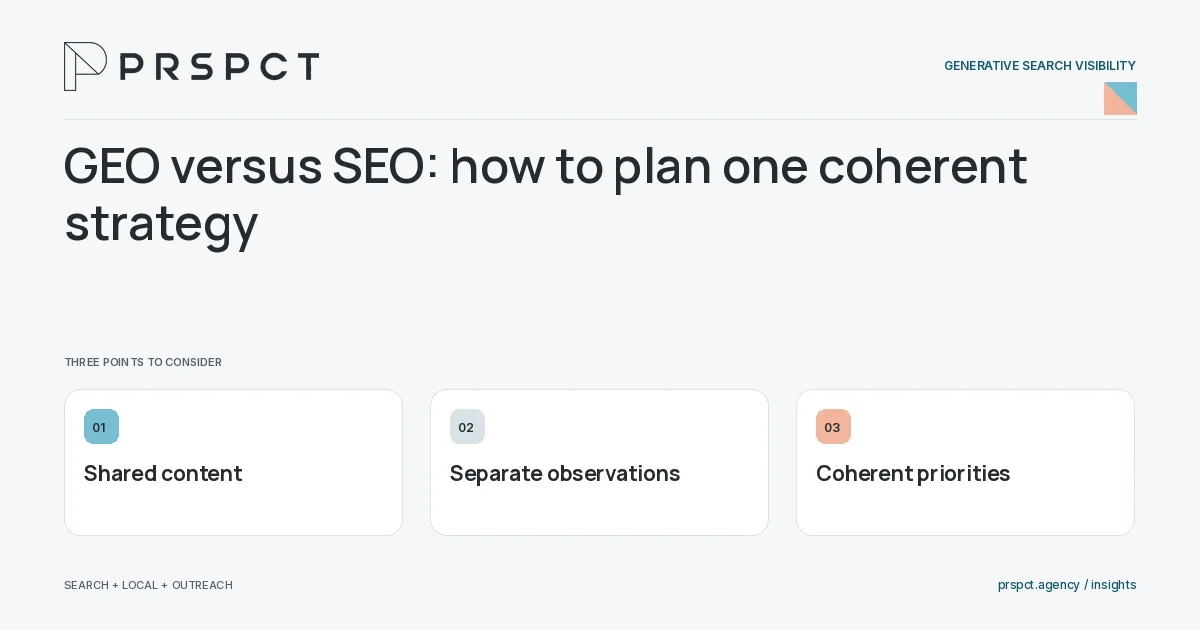
Plan around customer questions rather than competing terminology.
Share the topic map
Use the same intent boundaries and preferred URLs for the public content library.
Add observation methods
Record citations and answer accuracy separately from conventional clicks and positions where useful.
Prioritize proven needs
Fix factual gaps, access failures, and weak decision resources before experimenting with speculative tactics.
A practical example
A fictional service firm improves one canonical guide and observes both search visits and answer references. It avoids publishing an “AI edition” with the same paragraphs.
A decision checkpoint
If a proposal recommends a separate content stream, ask which distinct reader decisions it covers. Different goals may justify different assets, but labeling one stream SEO and another GEO does not establish a meaningful distinction. Keep the preferred URL for each actual intent documented.
A mistake to avoid
Treating GEO as a replacement for website quality can divert effort from the underlying answer.
How to assess the result
Review relevant discovery and inquiry outcomes while keeping each reporting method’s limitations visible.
Put the work in context
Generative engine optimization, or GEO, concerns visibility in AI-generated search answers. For PRSPCT, GEO means generative search, while local SEO refers separately to geographic discovery and business profiles.
Assess each search experience on its own terms. Record the query, product, date, location context where relevant, cited URL, and observed answer. A small manual sample is evidence of that sample, not a universal visibility score.
A common question
Do businesses need separate GEO pages?
Usually not. Create distinct pages for distinct reader tasks, not simply for a search-marketing label.
Related reading
- Generative engine optimization: a practical guide for businesses
- How to audit business information for AI search accuracy
- Does llms.txt help a business rank in Google AI search?
- Local SEO for small businesses: a practical foundation
Discuss your next priority
PRSPCT helps businesses connect search visibility, local presence, and email outreach. Email josh@prspct.agency to discuss your goals.
References and further reading
The references below support relevant platform definitions and requirements. The planning workflows and labeled examples are PRSPCT editorial guidance.