

Generative search visibility
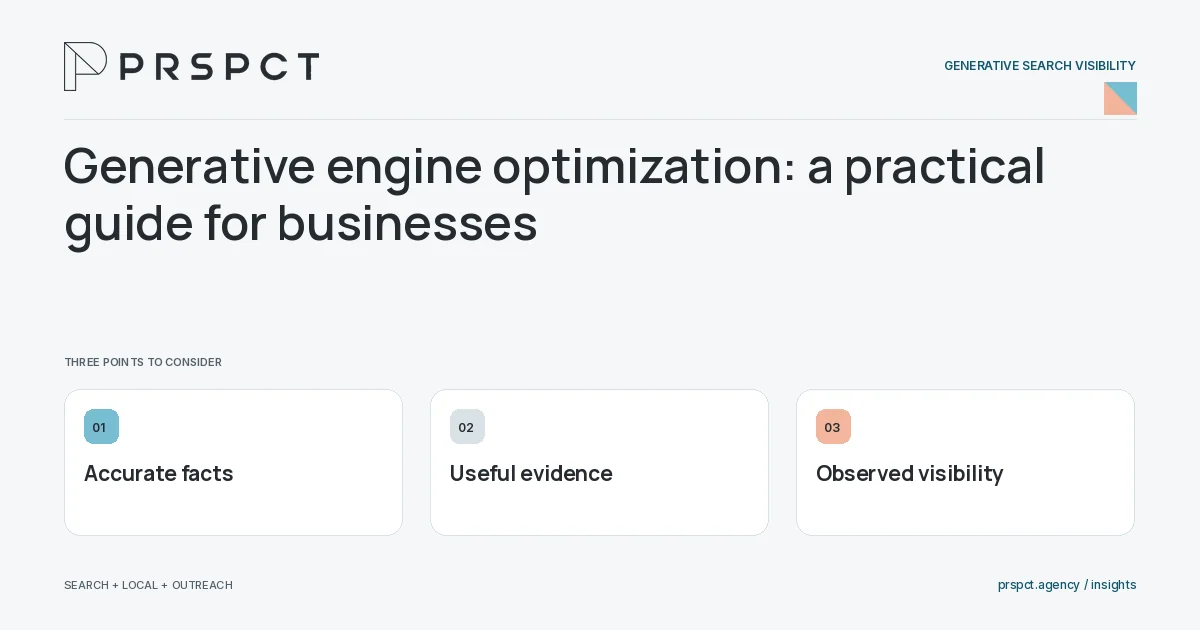
Generative engine optimization: a practical guide for businesses
Generative engine optimization, or GEO, describes work intended to help accurate business information become discoverable and usable in AI-generated search answers. Useful content, clear business facts, and accessible pages are practical foundations.
No publisher can guarantee that an answer system will cite a page.
Clarify the business facts
Keep services, audience, contact details, and scope consistent on the website and legitimate business profiles.
Provide original decision value
Publish explanations, examples, and resources that answer real questions more usefully than a generic summary.
Observe outcomes carefully
Check relevant searches and available reporting. Separate observed citations, referral visits, and resulting inquiries.
A practical example
A fictional consultancy publishes an original assessment checklist and clear service boundaries. It then observes whether relevant answer experiences reference the resource without promising inclusion.
A decision checkpoint
Treat generative-search work as an extension of publishing reliable useful information, with its own observation limits. A business cannot control the answer system’s full source selection. Focus spending on facts, resources, and technical access that remain valuable even when citation behavior changes.
A mistake to avoid
Buying fabricated mentions or manipulating answer systems is not a credible visibility strategy.
How to assess the result
Use documented samples and available platform reports, then connect useful referrals to actual inquiry quality.
Put the work in context
Generative engine optimization, or GEO, concerns visibility in AI-generated search answers. For PRSPCT, GEO means generative search, while local SEO refers separately to geographic discovery and business profiles.
Assess each search experience on its own terms. Record the query, product, date, location context where relevant, cited URL, and observed answer. A small manual sample is evidence of that sample, not a universal visibility score.
A common question
Is GEO different from local SEO?
Yes in this terminology. GEO means generative engine optimization; local SEO concerns nearby and location-based discovery.
Related reading
- GEO versus SEO: how to plan one coherent strategy
- AI referral traffic: how to interpret visits and leads
- Local SEO for small businesses: a practical foundation
Choose a related question
GEO versus SEO: how to plan one coherent strategy
SEO and GEO substantially overlap in useful, accessible content and clear business information. GEO adds a focus on how AI search answers reference sources, but it does not justify a separate duplicate website or unsupported optimization promises.
How to audit business information for AI search accuracy
Audit business information by comparing your website, legitimate profiles, and observed search answers against a verified fact record. Correct the underlying public source when services, contact details, or scope are inconsistent.
How to check whether AI search cites your website
Track AI search citations by recording relevant queries, the search product, observation date, cited URL, and answer context. Combine manual samples with available platform reporting, while distinguishing citation exposure from actual visits.
AI referral traffic: how to interpret visits and leads
AI referral traffic is website activity attributed to a recognizable AI search or assistant source in your analytics. It captures recorded visits, not every time a system mentioned or displayed your business.
Does llms.txt help a business rank in Google AI search?
Google’s current guidance says llms.txt is not needed for Google Search and does not improve or reduce search visibility. Prioritize useful public pages and technical access; maintain such a file only for a separate, identified use case.
Brand mentions in AI search: useful evidence versus manufactured buzz
Legitimate brand mentions can help people discover and evaluate a business, but manufactured mentions are not a sound substitute for useful work and accurate information. Seek relevant coverage for real expertise, resources, or activity.
Original resources for AI search: what a small business can publish
A small business can create original value through clear processes, decision checklists, practical comparisons, and supportable observations. Originality does not require invented research or a statistic attached to every paragraph.
How to respond when AI search describes your business incorrectly
When an AI answer misstates your business, document the error, inspect likely public sources, correct information you control, and use the product’s appropriate feedback channel. Avoid assuming the answer came from one particular page without evidence.
GEO reporting checklist: separate visibility from sales results
A GEO report should distinguish observed answer visibility, cited URLs, recorded referrals, answer accuracy, and business outcomes. Explain sampling methods and platform coverage instead of presenting one opaque score as a complete result.
Discuss your next priority
PRSPCT helps businesses connect search visibility, local presence, and email outreach. Email josh@prspct.agency to discuss your goals.
References and further reading
The references below support relevant platform definitions and requirements. The planning workflows and labeled examples are PRSPCT editorial guidance.