

Keyword research
How to group keywords without creating competing blog posts
Group keywords by the answer the searcher needs, not just shared words. Phrases belong together when one useful page can satisfy them without changing its main task.
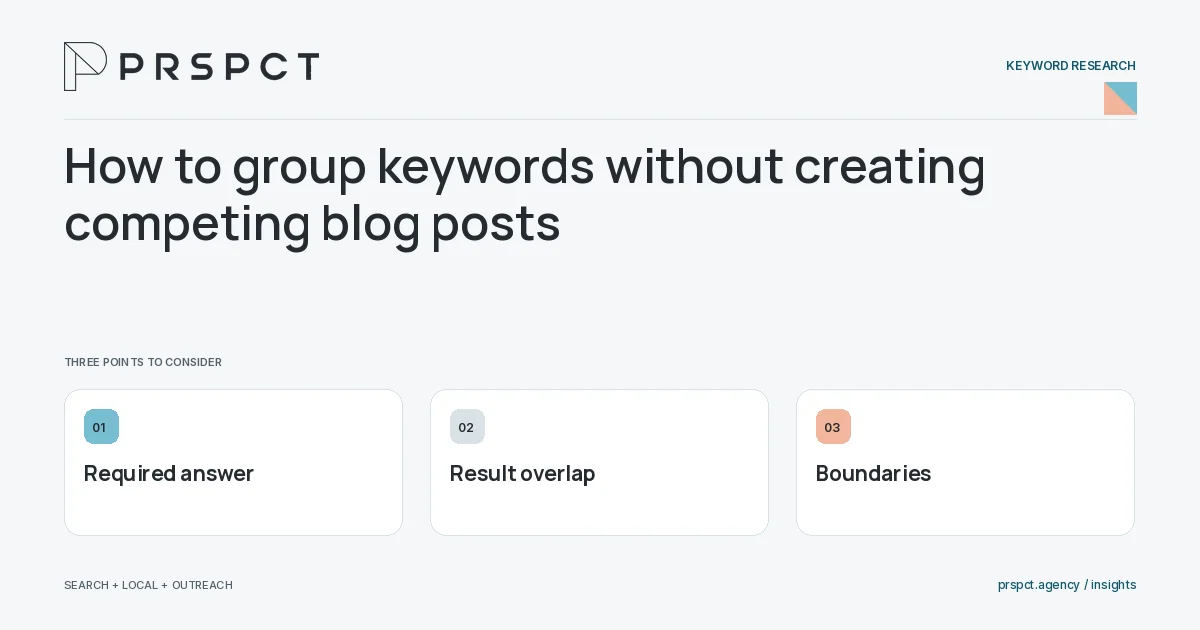
Text similarity alone can merge different decisions or split equivalent ones.
Describe the required answer
Write the expected outcome for each query. Distinguish definitions, checklists, comparisons, and service requests.
Compare current results
Look for overlap in the types and purposes of returned pages. Use judgment when results are mixed.
Set content boundaries
Document what each planned article covers and which related questions belong elsewhere.
A practical example
A fictional planner groups “newsletter frequency” with “how often to send a newsletter.” It keeps “best time to send a newsletter” separate because scheduling and frequency are different decisions.
A decision checkpoint
Give every cluster an explicit boundary sentence. For example, a frequency guide can discuss how often to send while linking to a separate scheduling guide for time-of-day decisions. The boundary helps writers maintain useful depth without gradually turning adjacent articles into competing versions of the same answer.
A mistake to avoid
Grouping solely by a common noun can create a page that tries to do too many jobs.
How to assess the result
Review overlap before publication and after meaningful query data appears. Consolidate when two pages repeatedly serve the same intent.
Put the work in context
Keyword research is most useful when it explains a customer decision. A short phrase can represent several different needs, while a longer query may identify a specific problem that the business can answer well.
Keep one primary intent for each planned page. Record close variants together, inspect the current results, and assign the topic to an existing URL whenever that page already serves the same decision.
A common question
Is keyword clustering fully automatic?
Tools can suggest groups, but editorial review is needed to confirm the reader’s task and the page’s useful boundaries.
Related reading
- Keyword research for small businesses: start with buyer intent
- How to choose keywords for a new website with little authority
- On-page SEO checklist for a small-business service page
Discuss your next priority
PRSPCT helps businesses connect search visibility, local presence, and email outreach. Email josh@prspct.agency to discuss your goals.
References and further reading
The references below support relevant platform definitions and requirements. The planning workflows and labeled examples are PRSPCT editorial guidance.