

Landing pages and conversion
Landing page optimization for service businesses
A useful service landing page matches the visitor’s intent, explains the offer, supports its claims, and provides a clear working action. Improve the decision path before focusing on decorative changes.
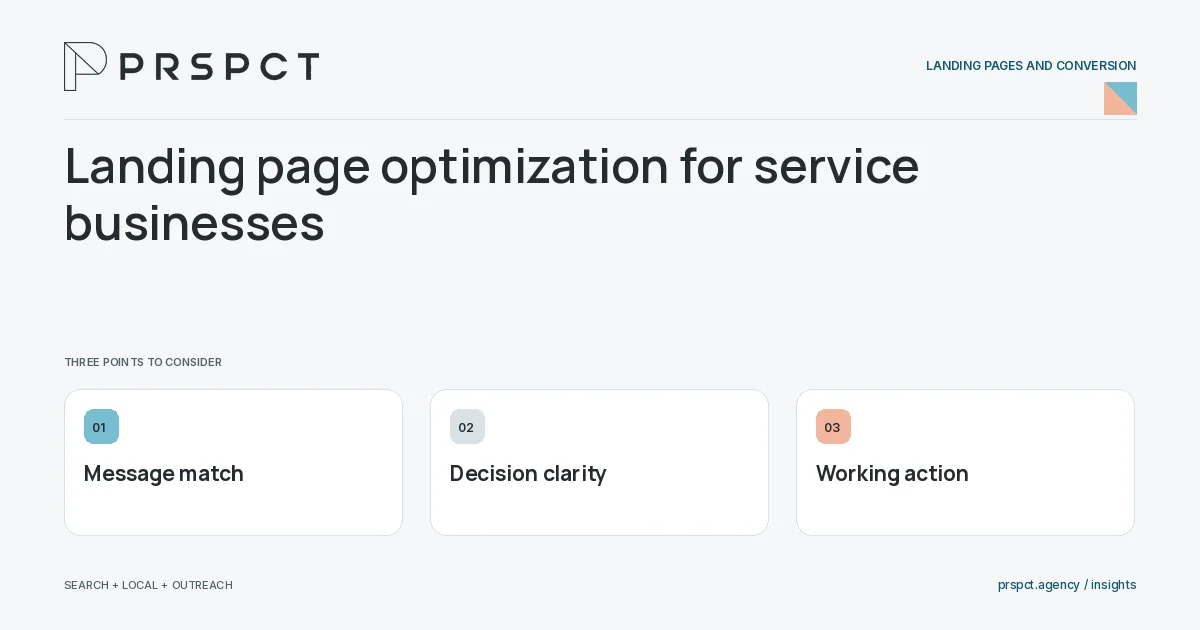
The page should fulfill the message that brought the visitor there.
Match the entry
Use the same service and audience context as the campaign or referral.
Explain the choice
Clarify fit, process, boundaries, and relevant evidence with readable sections.
Test the action
Verify form or booking behavior and real follow-through on mobile.
A practical example
A fictional campaign promises an assessment-preparation resource. Its landing page delivers that resource and explains the optional assessment conversation without an unrelated pitch.
A decision checkpoint
Check the page after the campaign is paused or changed. Saved links can continue sending visitors long after an email or advertisement stops running. Preserve a useful destination or handle retirement deliberately so an old promise does not lead to an error or an unrelated offer.
A mistake to avoid
A visually impressive page can fail when the offer is vague.
How to assess the result
Review valid inquiries and qualification alongside traffic and completion behavior.
Put the work in context
Conversion work should make the intended action easier for suitable visitors. Diagnose audience fit, message clarity, evidence, friction, and technical behavior before changing colors or adding more buttons.
Write the intended improvement and primary outcome before making changes. Keep a record of other releases and traffic shifts so that a before-and-after comparison is not mistaken for a controlled experiment.
A common question
Is a landing page always separate from the main website?
No. Use a dedicated page when a distinct campaign task warrants it.
Related reading
- Message match: connect your email to its landing page
- Trust signals on landing pages: use real evidence
- Lead qualification process for a small business
Choose a related question
Message match: connect your email to its landing page
Message match means the landing page clearly fulfills the promise, topic, and action of the message that led to it. Preserve context so visitors do not have to search for what they were offered.
How to write a landing page headline for a service offer
A service headline should identify the offer or useful outcome in terms the audience understands. Add a subheading for fit and scope rather than forcing every detail into one promotional sentence.
Calls to action for service businesses: make the request clear
A useful call to action tells the visitor what action to take and what it initiates. Match the request to readiness, and avoid implying a booking or deliverable the business cannot actually provide.
Trust signals on landing pages: use real evidence
Landing-page trust signals should help visitors assess real competence, process, and accountability. Use verified facts, approved examples, and genuine feedback rather than decorative badges or invented client proof.
Pricing information on service landing pages: what to explain
A service pricing page should explain the actual commercial model and factors that affect scope. Publish prices or commitments only when approved, and make the inquiry process clear when work requires individual scoping.
Landing page navigation: when to simplify the choices
Simplify landing-page navigation when extra choices distract from a clearly defined task, while preserving useful context and access. The right design depends on the visitor’s need to evaluate the business before acting.
Mobile landing pages: a conversion checklist
A mobile landing page should communicate the offer quickly, remain readable and stable, and support the intended action without obstruction. Test real inputs and loading behavior, not only the layout screenshot.
Conversion optimization for low-traffic websites
For a low-traffic website, start with usability checks, customer questions, technical verification, and clear offer information. Avoid declaring a winning variant from a tiny number of conversions.
A/B testing a landing page: what to define first
An A/B test needs a clear hypothesis, appropriate allocation, a meaningful primary outcome, and a plan for interpreting uncertainty. Define these before looking for a favorable result.
Discuss your next priority
PRSPCT helps businesses connect search visibility, local presence, and email outreach. Email josh@prspct.agency to discuss your goals.
References and further reading
The references below support relevant platform definitions and requirements. The planning workflows and labeled examples are PRSPCT editorial guidance.