

Local SEO
Local SEO checklist for a service-area business
A service-area business should describe its real coverage, maintain eligible business information, and explain how customers request service. Avoid implying a staffed customer-facing office where none exists.
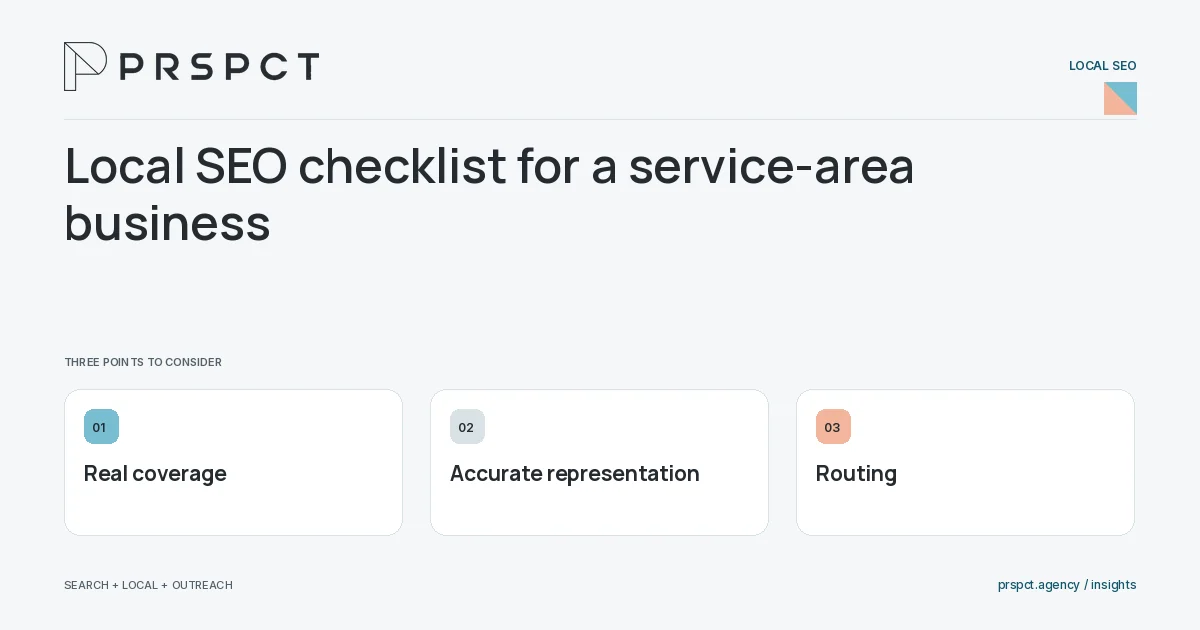
Coverage and physical location are different facts.
Confirm eligibility and address use
Follow the platform’s requirements for how the actual business operates and whether customers visit.
Explain service coverage
State workable areas and practical constraints on the website. Provide useful service details beyond a city list.
Check inquiry routing
Collect enough location information to confirm fit and route the request to the right person.
A practical example
A fictional mobile repair provider describes its coverage and travel limitations without inventing branch offices. Its form asks for the job location to confirm whether service is practical.
A decision checkpoint
Check the inquiry form against the stated footprint. If the business needs a job location to confirm service, ask for it clearly and explain the purpose. Avoid using a long location menu as a substitute for an accurate public coverage explanation.
A mistake to avoid
Virtual or fabricated locations can misrepresent the operation and create profile problems.
How to assess the result
Review inquiries outside coverage and questions that suggest customers misunderstand the service model.
Put the work in context
Local SEO helps a business present accurate, useful information for location-related decisions. Separate the work on website pages, legitimate listings, and customer experience rather than assuming one profile update controls every local result.
Use only real service coverage and eligible locations. Keep a verified business record for names, contact details, hours, and services, and assign an owner to update it when operations change.
A common question
Does listing a service area guarantee rankings throughout it?
No. Declaring coverage does not override the factors that affect local results.
Related reading
- Local SEO for small businesses: a practical foundation
- Near-me searches: how local businesses should approach them
- Local SEO mistakes that create the wrong inquiries
- Google Business Profile optimization checklist for small businesses
Discuss your next priority
PRSPCT helps businesses connect search visibility, local presence, and email outreach. Email josh@prspct.agency to discuss your goals.
References and further reading
The references below support relevant platform definitions and requirements. The planning workflows and labeled examples are PRSPCT editorial guidance.