

Local SEO
Near-me searches: how local businesses should approach them
For near-me searches, help customers and platforms understand your actual service, location context, and contact options. Use natural local information rather than stuffing the phrase “near me” into headings and business names.
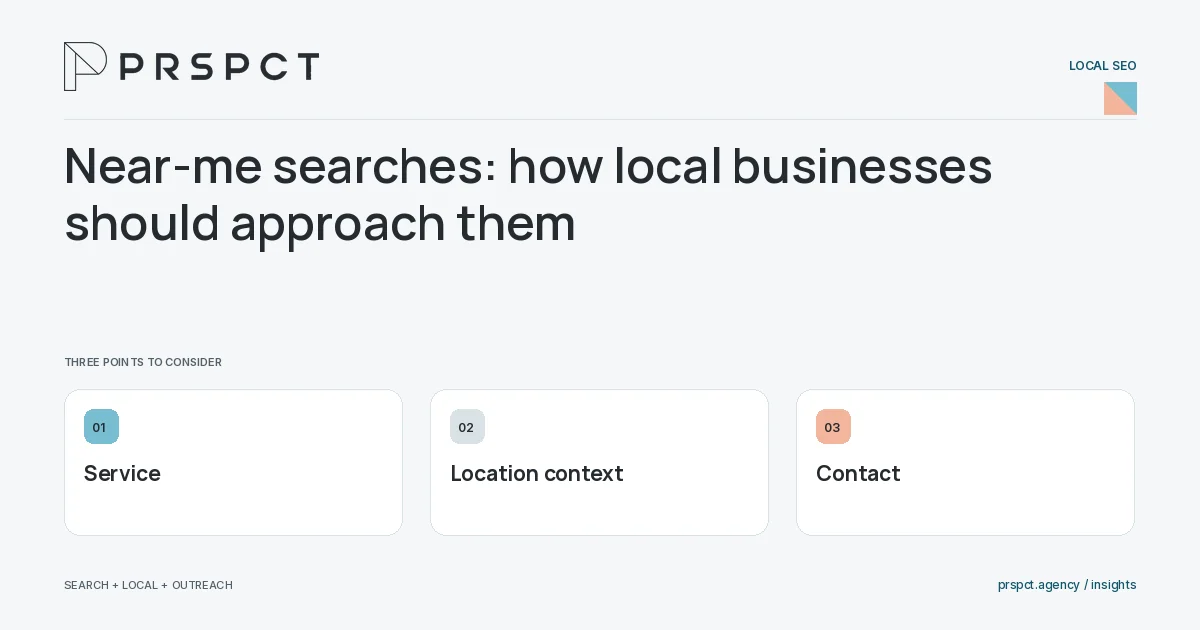
The searcher’s context can matter more than literal phrase repetition.
Clarify the service
Use accurate categories and useful page content that explain what the business actually offers.
Maintain location facts
Keep eligible profile and website information current. Distinguish storefronts from service coverage.
Support immediate decisions
Make hours, availability boundaries, and contact routes easy to find where relevant.
A practical example
A fictional maintenance business improves its service description and mobile contact path instead of renaming itself to include “near me.” Visitors can quickly confirm whether it serves their site.
A decision checkpoint
Do not interpret your own search result as the universal customer experience. The searcher’s location and context may change what appears. Record observed conditions and use actual suitable inquiries to complement manual visibility checks rather than relying on one favorable view.
A mistake to avoid
Keyword-stuffed business names misrepresent the brand and can conflict with platform guidance.
How to assess the result
Review local query relevance and suitable inquiries with awareness that observed positions vary by search context.
Put the work in context
Local SEO helps a business present accurate, useful information for location-related decisions. Separate the work on website pages, legitimate listings, and customer experience rather than assuming one profile update controls every local result.
Use only real service coverage and eligible locations. Keep a verified business record for names, contact details, hours, and services, and assign an owner to update it when operations change.
A common question
Should “near me” appear in every local page title?
No. Use a natural title that identifies the actual service and relevant location context.
Related reading
- Local SEO for small businesses: a practical foundation
- How to measure local SEO without one misleading ranking
- Local SEO for a business with multiple real locations
- Google Business Profile optimization checklist for small businesses
Discuss your next priority
PRSPCT helps businesses connect search visibility, local presence, and email outreach. Email josh@prspct.agency to discuss your goals.
References and further reading
The references below support relevant platform definitions and requirements. The planning workflows and labeled examples are PRSPCT editorial guidance.