

Keyword research
How to turn Search Console queries into blog ideas
Use Search Console queries to identify relevant questions where your pages already receive exposure. Inspect the associated page and intent before deciding whether to improve it or create a separate article.
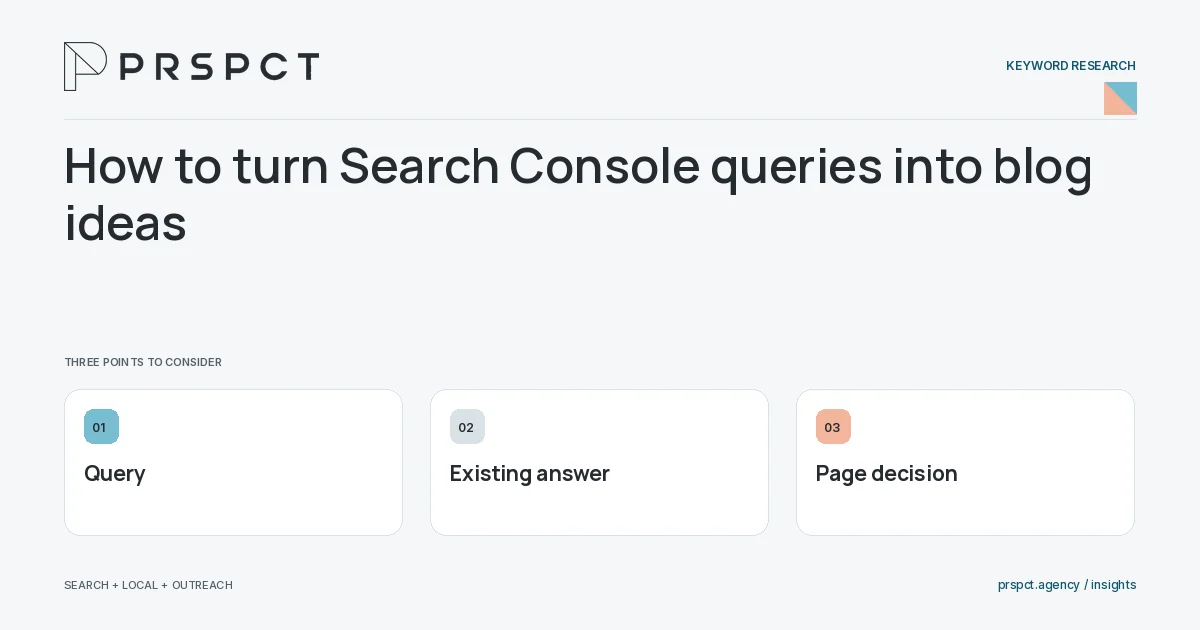
A query impression is a clue, not proof that a new URL is needed.
Filter to a useful page
Review queries for a specific service or guide. Remove irrelevant and navigational noise.
Identify answer gaps
Compare the query with visible content. Add a section when the existing page can answer it naturally.
Create only distinct resources
Use a separate article when the question has a different task, depth, or next step. Link the resources clearly.
A practical example
A fictional marketing firm sees preparation questions on an audit page. It adds a short preparation section there, then creates a separate document checklist only when the task requires a more detailed resource.
A decision checkpoint
Check whether the query needs a better answer or simply clearer signposting. Sometimes a useful section already exists but is buried beneath an unrelated introduction. Improving the page’s organization can serve the reader without adding another article or rewriting information that is already accurate.
A mistake to avoid
Creating a page for every reported query can multiply near-duplicate answers.
How to assess the result
Annotate changes and compare query relevance, clicks, and inquiry fit later. Do not judge a new article from a few impressions.
Put the work in context
Keyword research is most useful when it explains a customer decision. A short phrase can represent several different needs, while a longer query may identify a specific problem that the business can answer well.
Keep one primary intent for each planned page. Record close variants together, inspect the current results, and assign the topic to an existing URL whenever that page already serves the same decision.
A common question
Why does Search Console omit some queries?
Search reporting includes privacy and aggregation limits. Use the available data as a useful sample rather than a complete record of every search.
Related reading
- Keyword research for small businesses: start with buyer intent
- How to group keywords without creating competing blog posts
- Search intent explained for small-business content planning
- On-page SEO checklist for a small-business service page
Discuss your next priority
PRSPCT helps businesses connect search visibility, local presence, and email outreach. Email josh@prspct.agency to discuss your goals.
References and further reading
The references below support relevant platform definitions and requirements. The planning workflows and labeled examples are PRSPCT editorial guidance.