

Service and location pages
How to add proof to a service page without invented claims
Service-page proof should use verifiable facts, permissioned examples, accurate process descriptions, and genuine feedback. If client results are unavailable, explain the work clearly instead of inventing logos, numbers, or testimonials.
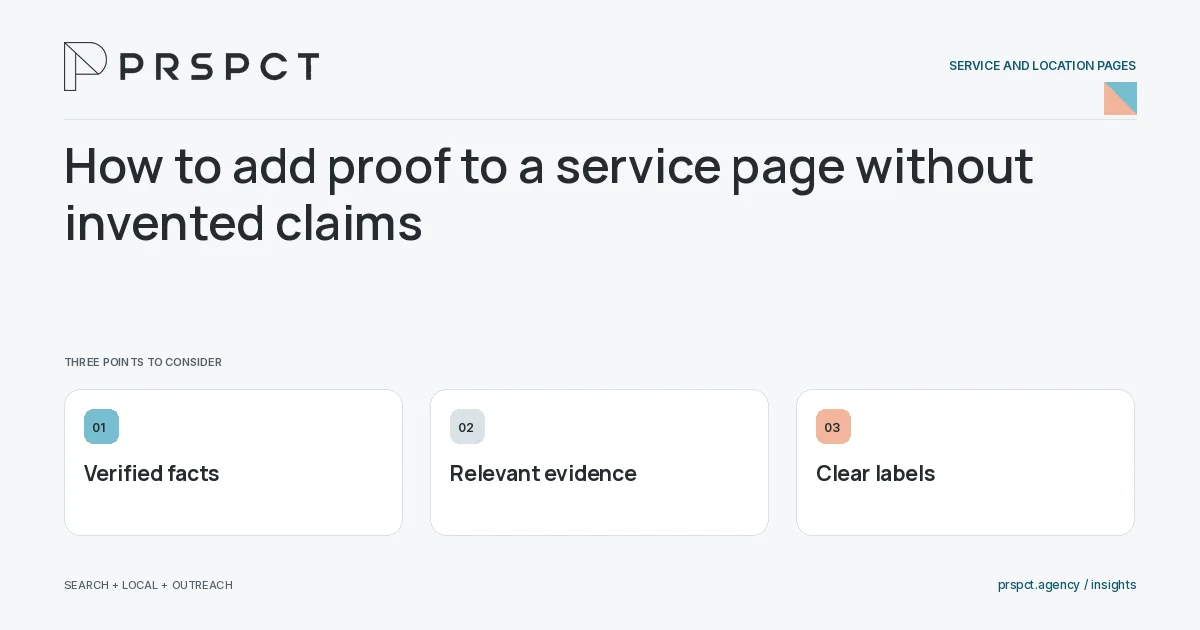
A new business can be credible without pretending to have an established track record.
Inventory supportable evidence
List real qualifications, process artifacts, approved work examples, and permitted feedback.
Explain relevance
Show how each fact helps the customer evaluate the specific service.
Check the claims
Verify permission, dates, scope, and limitations before publication.
A practical example
A fictional new consultancy shows a sample assessment structure labeled as illustrative. It does not present that sample as a completed client engagement.
A decision checkpoint
Separate evidence of process from evidence of results. A sample checklist can demonstrate how work is organized, but it cannot prove a client outcome. Label the distinction clearly so a useful explanatory asset is not accidentally presented as a success story.
A mistake to avoid
Decorative client logos without a real relationship mislead visitors.
How to assess the result
Maintain an evidence record and review claims when services or permissions change.
Put the work in context
A service or location page should help a visitor evaluate a real offering in a real delivery context. Shared structure can make the site consistent, but city-name substitutions alone do not create useful distinct pages.
Before creating a URL, confirm the service, audience, coverage, evidence, and next step. Link overlapping resources appropriately and avoid implying a physical office where the business only travels to customers.
A common question
Can a process explanation count as useful evidence?
Yes. It can show how work is approached, while remaining distinct from proof of measured client outcomes.
Related reading
- Service-area pages: when they deserve separate URLs
- How to organize a service website with several offerings
- Lead generation for small businesses: build the full path
Discuss your next priority
PRSPCT helps businesses connect search visibility, local presence, and email outreach. Email josh@prspct.agency to discuss your goals.
References and further reading
The references below support relevant platform definitions and requirements. The planning workflows and labeled examples are PRSPCT editorial guidance.