

Digital marketing strategy
How to set a small-business marketing budget from sales goals
Set a marketing budget by working backward from customer value, sales capacity, and affordable acquisition cost. Separate setup costs from recurring activity and reserve capacity for following up with the inquiries the spending is intended to generate.
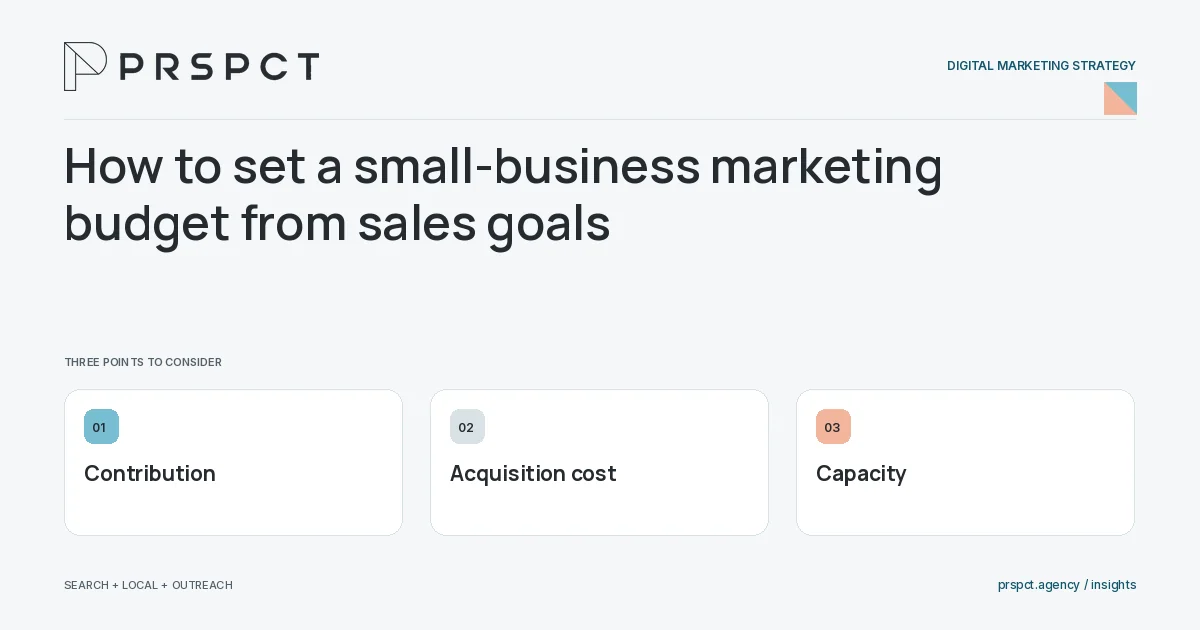
A percentage of revenue can be a starting reference, but it does not explain whether a specific campaign is affordable. A service with strong repeat business can support different acquisition economics from a low-margin one-off project.
Estimate contribution before acquisition
Subtract direct delivery costs from expected customer revenue. Keep uncertain repeat purchases separate from revenue you can reasonably expect.
Model the full path
Estimate inquiry-to-customer conversion and sales effort using your own records. Use conservative scenarios when the business has little historical data.
Release spending in stages
Fund essential setup first and test the channel at a manageable scale. Increase only after lead quality and operational capacity justify it.
A practical example
Illustrative arithmetic: if a customer contributes $1,000 before acquisition and the business allocates $200 to acquisition, a 20% qualified-inquiry close rate implies a $40 qualified-inquiry allowance. These invented inputs explain the calculation; they are not industry benchmarks.
A decision checkpoint
Run a conservative version of the budget calculation using lower conversion and higher service costs. If the plan becomes unaffordable under a plausible scenario, reduce the pilot or improve the economics first. Keep projected repeat revenue distinct from money already earned so cash needs remain visible.
A mistake to avoid
Using revenue alone to justify spending can overlook delivery costs, refunds, and the time required to close the sale.
How to assess the result
Reconcile actual campaign, software, creative, and sales costs. Compare the combined cost with customers won and their realized contribution, not just projected lifetime value.
Put the work in context
An owner-led business needs a marketing plan that fits its capacity to answer inquiries and deliver the work. A channel that creates demand faster than the team can respond can waste otherwise useful attention.
Assign one person to maintain the plan. Keep the audience, offer, channel, spending, and sales response in the same document so that a change in one area is visible to everyone responsible for the result.
A common question
What percentage of revenue should go to marketing?
There is no universal percentage. Use margins, cash flow, growth goals, and tested acquisition economics to choose a level the business can sustain.
Related reading
- Digital marketing for small businesses: a practical starting plan
- Digital marketing audit checklist for small businesses
- How to write a marketing brief an agency can use
- SEO for small businesses: what to fix first
Discuss your next priority
PRSPCT helps businesses connect search visibility, local presence, and email outreach. Email josh@prspct.agency to discuss your goals.
References and further reading
The references below support relevant platform definitions and requirements. The planning workflows and labeled examples are PRSPCT editorial guidance.