

Service and location pages
How to write a service page that qualifies inquiries
A strong service page explains what the business does, who it fits, how the process works, important boundaries, and the next step. It helps appropriate prospects act while reducing avoidable mismatches.
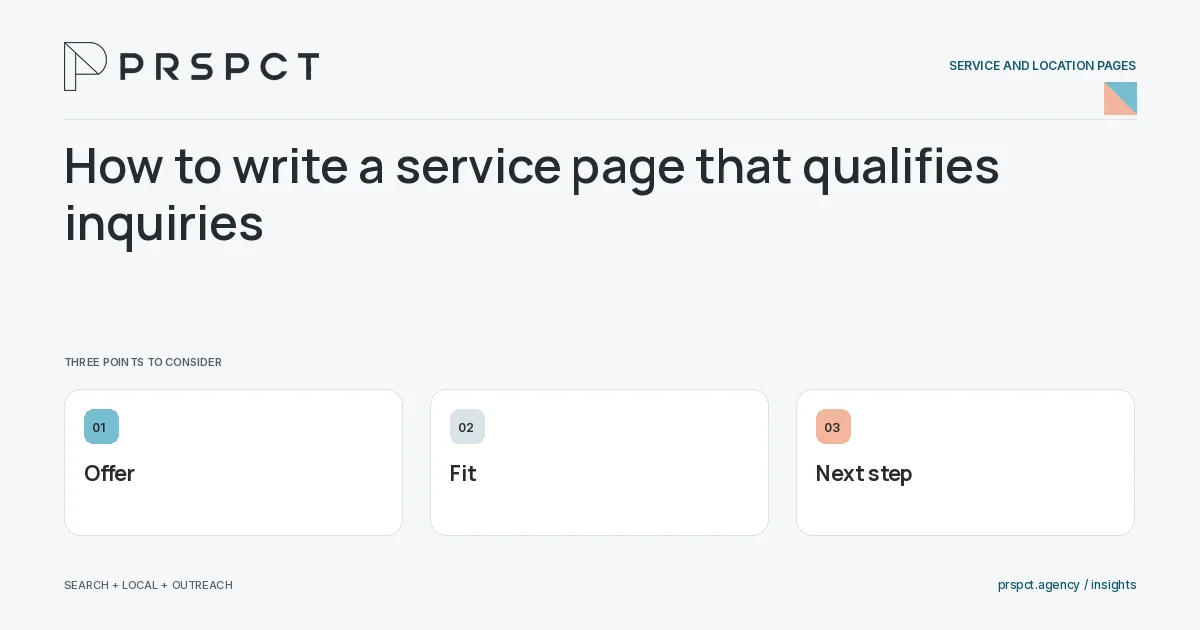
Clarity can improve inquiry quality even without increasing traffic.
Define fit
Name relevant customer situations and exclusions in plain language.
Explain the process
Show what happens before, during, and after an inquiry using facts the business can deliver.
Make action specific
Tell visitors what to provide and what the request initiates. Avoid unsupported response-time promises.
A practical example
A fictional bookkeeping page clarifies that the offer is recurring support, then explains the initial records review. One-time tax questions are directed appropriately.
A decision checkpoint
Use exclusion information respectfully. Explain what the service is designed for and when another route may be more appropriate. Clear boundaries help suitable prospects understand the offer and save unsuitable visitors from completing a form that cannot lead to useful assistance.
A mistake to avoid
Hiding service boundaries to maximize submissions creates work for both sides.
How to assess the result
Track valid and qualified inquiries plus recurring scope questions.
Put the work in context
A service or location page should help a visitor evaluate a real offering in a real delivery context. Shared structure can make the site consistent, but city-name substitutions alone do not create useful distinct pages.
Before creating a URL, confirm the service, audience, coverage, evidence, and next step. Link overlapping resources appropriately and avoid implying a physical office where the business only travels to customers.
A common question
Should service pages include FAQs?
Use them for genuine remaining questions, while keeping major buying information in the main page flow.
Related reading
- Service-area pages: when they deserve separate URLs
- City pages versus regional pages: how to choose
- How to add proof to a service page without invented claims
- Lead generation for small businesses: build the full path
Discuss your next priority
PRSPCT helps businesses connect search visibility, local presence, and email outreach. Email josh@prspct.agency to discuss your goals.
References and further reading
The references below support relevant platform definitions and requirements. The planning workflows and labeled examples are PRSPCT editorial guidance.